SDG 11: Sustainable Cities and Communities Report

Loading
Admissions Closing Soon for 2026-27
Apply NowSustainable Development Goal 11 (SDG 11) aims to "Make cities and human settlements inclusive, safe, resilient, and sustainable." It focuses on sustainable urban development through resilient infrastructure, environmental conservation, resource efficiency, cultural heritage preservation, disaster resilience, and inclusive communities. Higher education institutions play a significant role in achieving this goal by promoting sustainability through education, research, innovation, community engagement, and environmentally responsible campus practices.

Scholarly Output
Citation Count
Field-Weighted Citation Impact (FWCI)
Environmental Awareness and Sustainability Activities
Workshops and Skill Development Programmes
Innovation, Start-up and Entrepreneurship Events
Conferences, Seminars and Academic Programmes
Cultural, Youth and Alumni Activities
Legal Awareness and Human Rights Activities
National and Professional Observances
Technology and Research Conferences
Community Outreach and Social Welfare Activities
Overview
Kalinga University, Raipur, is committed to preserving, promoting, and celebrating India's rich cultural heritage while fostering creativity, inclusivity, and community engagement in alignment with United Nations Sustainable Development Goal 11 (Sustainable Cities and Communities). Recognizing that arts and cultural heritage are essential components of sustainable societies, the University integrates cultural preservation, artistic expression, and heritage awareness into its academic, co-curricular, and extension activities.
Located in Naya Raipur, Chhattisgarh, a state renowned for its rich tribal traditions, folk arts, music, dance, handicrafts, and archaeological heritage, Kalinga University actively promotes the preservation and dissemination of local and national cultural heritage. Through its Schools of Humanities, Education, Fine Arts-related activities, NSS, NCC, student clubs, and cultural societies, the University provides students with opportunities to engage with India's diverse artistic and cultural traditions.
The University organizes a wide range of cultural programmes, including traditional festivals, folk dance and music performances, theatre, literary events, art exhibitions, heritage lectures, cultural competitions, and national celebrations, encouraging students to appreciate and preserve the country's tangible and intangible cultural heritage. These events also promote intercultural dialogue, social inclusion, and respect for India's diverse cultural identities.
Kalinga University actively supports the conservation and promotion of Chhattisgarh's indigenous tribal heritage, including traditional crafts, folk literature, local music, dance forms, and indigenous knowledge systems, by collaborating with local artists, cultural organizations, government agencies, and community groups. Students participate in heritage awareness programmes, field visits to historical monuments and museums, and community outreach activities that strengthen their understanding of cultural preservation and sustainable community development.
The University also provides access to cultural resources through its Central Library, digital learning resources, seminars, exhibitions, and academic programmes that encourage research on history, culture, literature, archaeology, and heritage conservation. Faculty members and students undertake research and documentation on regional culture, indigenous traditions, and sustainable cultural practices, contributing to the preservation and dissemination of local knowledge.
Through its continued support for arts, culture, and heritage, Kalinga University fosters an inclusive campus environment that values cultural diversity, strengthens community identity, and promotes sustainable development. These initiatives demonstrate the University's commitment to SDG 11: Sustainable Cities and Communities by preserving cultural heritage, supporting artistic expression, and ensuring that cultural resources remain accessible to present and future generations.
Year: 2024
Overview
Kalinga University, Raipur, is committed to promoting public access to educational, cultural, and community spaces that contribute to lifelong learning, cultural exchange, and sustainable community development in alignment with United Nations Sustainable Development Goal 11 (Sustainable Cities and Communities). The University encourages members of the public, schools, community organizations, government agencies, alumni, researchers, and industry representatives to access its academic and cultural infrastructure through various institutional programmes and public events.
The University campus provides access to key facilities such as the Central Library, auditoriums, seminar halls, conference facilities, open-air venues, sports complexes, and exhibition spaces for educational, cultural, and community-oriented activities. These facilities host conferences, workshops, exhibitions, cultural festivals, public lectures, awareness campaigns, and outreach programmes that are open to external participants upon invitation or registration. The University also offers a virtual campus tour and maintains visitor-friendly infrastructure to facilitate public engagement with its academic environment.
Kalinga University regularly organizes cultural programmes such as Kalinga Utsav, national festivals, folk dance and music performances, literary events, exhibitions, and celebrations of regional festivals including Hareli and Teeja. These events showcase the cultural heritage of Chhattisgarh and India while providing opportunities for the wider community to participate in and appreciate local traditions and cultural diversity.
The University's Central Library serves as an important knowledge resource with extensive collections of books, journals, digital resources, and e-learning databases. Through library services, seminars, exhibitions, and academic events, the University promotes access to knowledge and cultural resources for students, researchers, academicians, and invited members of the public. The University also provides authenticated off-campus access to electronic resources for its academic community, supporting continuous learning and research.
By providing access to its educational infrastructure, cultural facilities, and community spaces, Kalinga University strengthens public engagement, promotes cultural appreciation, and supports the preservation and dissemination of knowledge, thereby contributing to SDG 11: Sustainable Cities and Communities.
Year: 2024
Overview
Kalinga University, Raipur, is committed to promoting equitable access to knowledge, information, and lifelong learning by providing access to its library resources for students, faculty members, researchers, alumni, visiting scholars, and external academic stakeholders. In alignment with United Nations Sustainable Development Goal 11 (Sustainable Cities and Communities), the University supports public access to books, scholarly publications, digital resources, and learning materials that contribute to education, research, cultural preservation, and community development.
The Central Library of Kalinga University serves as a comprehensive knowledge hub with a rich collection of printed books, reference materials, national and international journals, magazines, newspapers, theses, dissertations, and digital learning resources covering diverse disciplines. The Library is equipped with modern ICT facilities, an Online Public Access Catalogue (OPAC), reading halls, internet-enabled services, and subscriptions to electronic databases, ensuring efficient access to academic resources.
The University welcomes research scholars, academicians, alumni, industry professionals, and visitors from educational institutions to utilize library resources for academic and research purposes, subject to the University's library rules and membership or visitor policies. The Library also supports collaborative learning through orientation programmes, book exhibitions, reading promotion activities, information literacy sessions, and awareness programmes that encourage the effective use of library resources.
In addition to physical collections, Kalinga University provides access to a wide range of e-books, e-journals, institutional publications, and digital databases, enabling users to access scholarly information and research publications. The University encourages the dissemination of knowledge through institutional publications, conference proceedings, research journals, and other academic resources that contribute to sustainable education and community learning.
By providing accessible library facilities and promoting knowledge sharing, Kalinga University strengthens education, research, and cultural development while contributing to SDG 11: Sustainable Cities and Communities by ensuring that learning resources remain accessible to the wider academic and community ecosystem.
Year: 2024
Overview
Kalinga University, Raipur, is committed to promoting public access to art, culture, and heritage by organizing exhibitions, cultural displays, academic exhibitions, and awareness programmes that are accessible to students, researchers, visitors, schools, and the local community. In alignment with United Nations Sustainable Development Goal 11 (Sustainable Cities and Communities), the University encourages the preservation and dissemination of cultural heritage through exhibition spaces, art displays, and community-oriented cultural events.
The University regularly hosts art exhibitions, science and technology exhibitions, cultural exhibitions, project exhibitions, literary events, and heritage-themed programmes in its auditoriums, seminar halls, exhibition spaces, and open campus venues. These events showcase students' creative works, research projects, traditional crafts, paintings, sculptures, photographs, and innovations while providing opportunities for public participation and knowledge exchange.
Kalinga University also celebrates national festivals, tribal cultural programmes, folk art performances, handicraft exhibitions, and literary festivals, highlighting the rich cultural heritage of Chhattisgarh and India. These programmes are organized in collaboration with government agencies, educational institutions, artists, and community organizations, promoting awareness of local traditions, indigenous knowledge, and cultural diversity.
Although the University does not maintain a permanent public museum, it provides temporary exhibition spaces and galleries for displaying academic achievements, cultural artefacts, artworks, traditional crafts, research innovations, and thematic exhibitions during conferences, festivals, awareness campaigns, and outreach programmes. The University also encourages students and visitors to participate in educational visits to museums, heritage sites, archaeological monuments, and art galleries to enhance cultural understanding and heritage appreciation.
Through these initiatives, Kalinga University promotes creativity, cultural preservation, public engagement, and lifelong learning, thereby contributing to SDG 11: Sustainable Cities and Communities by making cultural and educational resources accessible to society.


“Workshop on Best out of waste” “Workshop on Scientific toy”
Date of Event: 10th to 12th May 2023 Date of Event: 1st to 3rd December 2023


Drone Technology Workshop Workshop on Portable Microscope / Foldscope”
29th November to 3rd December 2022 28-02-2023 to 02-03-2023


“Donation Drive: Donate to Make a Difference”
(under Unnat Bharat Abhiyan)
Annexure :3


Guest Lecture on
“Innovation/Prototype Validation –Converting Innovation into a Start-up”
Organized by the Marketing Club “Mercadeo”Faculty of Commerce and Management,
Kalinga University
Annexure : 4


“A Session on Startup Summit: Demo Day/Exhibition of Startups &Linkage with
Innovation Ambassadors/Experts for Mentorship Support”Related to SDG No.(s)
Organized by “Faculty of Technology” In Association With Institutions Innovation Council
Annexure : 5


National Seminar on From Vachanas to Vision:Mahatma Basaveshwara’s Ideas in Contemporary Society Related to SDG No.(s) Organized by: “Shaheed Veer Narayan Singh Research Chair (Faculty of Arts & Humanities & Faculty of Law)”
In Association with
“Innovation and Integrative Research Center Journal (IIRCJ)
Annexure.: 6


Surana & Surana Judex 3.0
Human Rights Law Moot Court competition
Annex.: 7
Legal Aid Activity
On
Legal Awareness regarding Domestic Safety & Avoidance of Violence
Annex.: 8

ICSTDTSD 2025
Annex.: 9
“2nd International Conference on Chhattisgarh@2047: Transforming Education through Sustainability Innovation Inclusion & Indian Knowledge System“
Annex.: 10
IEEE 3rd International World Conference on Communication & Computing 2025
Annex.: 11
2nd Alumni Meet (Raipur Chapter) Organized by “Alumni Association Kalinga University
Annex.: 12
Two-Week Online Faculty Development Programme (FDP) on the theme "Emerging Trends in Research and Innovative Teaching Pedagogy
Annex.: 13
Guest Lecture On Lean Start Up &Minimum Viable Product/Business Boot Camp or Mentoring Session
Annex.: 14
The 76th Year of the Indian Constitution Day Celebration
With a Focus on
“Dignity Beyond Text: POSH as an Instrument to Enforce Article
14 & 15 of the Constitution of India”
Annex.: 15
Engineers Day Celebration
Annex.: 16

Tourism Treasure Hunt 2025 Incredible India and Chhattisgarh On the Occasion of
World Tourism Day
Annex.: 17
Open Mic: Youth Voices “A celebration of youth expression and empowerment
Annex.: 18
Global Conference on Cyber Violence and Digital Deception: Undertaking, Preventing and Responding to Technology Facilitated Crimes
Year: 2024
Overview
Kalinga University, Raipur, is committed to promoting environmental sustainability, biodiversity conservation, and community well-being by providing free public access to its open and green spaces. In alignment with United Nations Sustainable Development Goal 11 (Sustainable Cities and Communities), the University has developed a green, eco-friendly campus that encourages environmental awareness, recreation, and healthy lifestyles for students, staff, visitors, and the local community.
The University campus features well-maintained gardens, landscaped lawns, tree-lined avenues, medicinal plant gardens, open recreational areas, biodiversity-rich green zones, and pedestrian-friendly pathways that are accessible to visitors during University working hours and public events. These green spaces provide opportunities for relaxation, environmental education, outdoor learning, cultural activities, fitness, and community interaction while enhancing the ecological quality of the campus.
Kalinga University regularly organizes tree plantation drives, biodiversity conservation programmes, environmental awareness campaigns, cleanliness drives, Yoga Day celebrations, Nature Day activities, and World Environment Day programmes in its open green spaces. These activities are conducted in collaboration with NSS, NCC, Eco Clubs, student organizations, government agencies, NGOs, and local communities, promoting public participation in environmental conservation and sustainable living.
The University's green campus also incorporates sustainable practices such as rainwater harvesting, energy-efficient landscaping, waste segregation, water conservation, and biodiversity enhancement, creating a healthy and environmentally responsible campus environment. During educational visits, outreach programmes, cultural events, seminars, and environmental campaigns, members of the public are encouraged to utilize these open spaces for learning, awareness, and recreation.
Through the provision of accessible green spaces and environmentally sustainable campus infrastructure, Kalinga University contributes significantly to SDG 11: Sustainable Cities and Communities by fostering ecological sustainability, public health, and community engagement.
Year: 2024
Overview
Kalinga University, Raipur, actively contributes to the promotion and preservation of local arts, culture, and heritage by organizing and supporting a wide range of public cultural performances and artistic events throughout the year. In alignment with United Nations Sustainable Development Goal 11 (Sustainable Cities and Communities), the University provides a vibrant platform for students, faculty members, local artists, and community groups to celebrate the rich cultural traditions of Chhattisgarh and India while strengthening community engagement and cultural diversity.
The University regularly organizes annual cultural festivals, folk dance performances, music concerts, theatre productions, literary programmes, traditional art exhibitions, street plays (Nukkad Natak), patriotic events, and inter-university cultural competitions. These programmes are open to students, parents, alumni, invited schools, local communities, government organizations, and the general public, encouraging wider participation in arts and cultural activities.
Kalinga University celebrates important national and regional festivals such as Independence Day, Republic Day, International Yoga Day, Hareli, Teeja, Navratri, and other cultural occasions, featuring performances of folk dance, folk music, drama, poetry recitation, classical and contemporary music, and traditional cultural presentations. These events provide opportunities for students to showcase their talents while preserving and promoting the cultural heritage of the region.
The University also encourages student participation through its Cultural Club, NSS, NCC, Literary Club, Music and Dance Groups, and departmental cultural societies, which regularly organize public performances, awareness programmes, and community outreach activities. Street plays and cultural performances are conducted on themes such as environmental conservation, health awareness, gender equality, social harmony, road safety, and sustainable development, using art as a medium for public education and community engagement.
By promoting cultural performances and supporting local artists, Kalinga University strengthens the connection between higher education and society, contributes to the preservation of intangible cultural heritage, and fosters appreciation of India's diverse artistic traditions. These initiatives demonstrate the University's commitment to SDG 11: Sustainable Cities and Communities by making arts and cultural heritage accessible to the wider community.
Year: 2024
Overview
Kalinga University, Raipur, is committed to preserving and promoting the intangible cultural heritage of India, with particular emphasis on the rich tribal and folk traditions of Chhattisgarh. In alignment with United Nations Sustainable Development Goal 11 (Sustainable Cities and Communities), the University undertakes academic, research, documentation, and community engagement initiatives to record, preserve, and disseminate local folklore, traditional knowledge, indigenous languages, performing arts, customs, and cultural practices for future generations.
The University encourages faculty members, researchers, and students to undertake research, field studies, documentation projects, and community-based learning on the cultural heritage of local and tribal communities. Through academic programmes, seminars, conferences, cultural festivals, and extension activities, Kalinga University promotes the documentation and preservation of folk literature, oral traditions, indigenous knowledge systems, traditional arts and crafts, folk music, folk dances, tribal customs, local languages, and traditional ecological knowledge.
Kalinga University collaborates with local communities, cultural organizations, government departments, educational institutions, and subject experts to organize heritage awareness programmes, cultural exhibitions, folk performances, traditional festivals, and community outreach activities. These initiatives provide opportunities for students to interact with local communities, document traditional practices, and appreciate the cultural diversity of the region.
The University also promotes research publications, conference proceedings, student projects, dissertations, and digital documentation related to regional history, literature, folklore, and cultural heritage. Through its Central Library, institutional repository, and academic publications, the University contributes to the preservation and dissemination of knowledge on India's diverse cultural traditions.
By integrating cultural preservation into teaching, research, and community engagement, Kalinga University actively contributes to safeguarding intangible cultural heritage while strengthening cultural identity, social inclusion, and sustainable community development. These initiatives support the objectives of SDG 11: Sustainable Cities and Communities by ensuring that traditional knowledge and cultural heritage are documented, preserved, and shared with present and future generations.
Annexure:
International Yoga Day
.

Certification Training Program Jan Shikshan Sansthan (JSS)


Poster Making Competition on Theme “Harmony with Nature: Cultivating a Greener Tomorrow”


Painting competition for celebrating World Ozone Day 2023


World Wetlands Day, 2024

Paper Bag Distribution Campaign


UNNAT BHARAT ABHIYAN


Nature Camp and Workshop on Termites and Birds Identification
| S. No. | Name of Event | Estimated No. of Students Participated | Outcome of the Event |
|---|---|---|---|
| 1 | International Yoga Day | 150 | Promoted physical and mental well-being, healthy lifestyles, and a healthier campus community. |
| 2 | Certification Training Programme – Jan Shikshan Sansthan (JSS) | 30 | Enhanced practical skills, employability, and opportunities for skill-based learning. |
| 3 | Poster Making Competition – “Harmony with Nature: Cultivating a Greener Tomorrow” | 40 | Developed environmental awareness and encouraged creative expression on sustainability. |
| 4 | Painting Competition for World Ozone Day 2023 | 35 | Increased awareness of ozone-layer protection and environmental conservation. |
| 5 | World Wetlands Day 2024 | 60 | Improved awareness of wetland conservation, biodiversity, and ecosystem protection. |
| 6 | Paper Bag Distribution Campaign | 80 | Encouraged alternatives to single-use plastic and promoted responsible consumption. |
| 7 | Unnat Bharat Abhiyan (UBA) | 50 | Strengthened student engagement in rural development and community-oriented activities. |
| 8 | Nature Camp and Workshop on Termites and Birds Identification | 35 | Improved understanding of biodiversity, species identification, and ecological conservation. |
| 9 | Workshop on Best Out of Waste | 40 | Promoted waste reduction, reuse, recycling, and creative resource utilization. |
| 10 | Workshop on Scientific Toy | 40 | Encouraged experiential learning, scientific thinking, and low-cost educational innovation. |
| 1 | Drone Technology Workshop | 60 | Introduced students to drone technology, its applications, and emerging technical skills. |
| 12 | Workshop on Portable Microscope/Foldscope | 40 | Familiarized students with affordable scientific tools and practical observation techniques. |
| 13 | Donation Drive – “Donate to Make a Difference” under UBA | 50 | Encouraged social responsibility, community support, and a culture of giving. |
| 14 | Guest Lecture on “Innovation/Prototype Validation – Converting Innovation into a Start-up” | 70 | Improved understanding of prototype validation, entrepreneurship, and innovation commercialization. |
| 15 | Startup Summit – Demo Day/Exhibition of Start-ups and Mentorship Linkages | 100 | Provided exposure to start-up ideas, expert mentoring, innovation networks, and entrepreneurial opportunities. |
| 16 | National Seminar – “From Vachanas to Vision: Mahatma Basaveshwara’s Ideas in Contemporary Society” | 100 | Promoted ethical values, social inclusion, cultural awareness, and interdisciplinary discussion. |
| 17 | Surana & Surana Judex 3.0 – Human Rights Law Moot Court Competition | 80 | Developed legal reasoning, advocacy, public speaking, and awareness of human rights. |
| 18 | Legal Aid Activity on Domestic Safety and Avoidance of Violence | 60 | Increased awareness of legal rights, domestic safety, and mechanisms for seeking assistance. |
| 19 | ICSTDTSD 2025 | 120 | Supported academic exchange, research dissemination, and discussion of emerging developments relevant to sustainable development. |
| 20 | 2nd International Conference on Chhattisgarh@2047: Transforming Education through Sustainability, Innovation, Inclusion and Indian Knowledge System | 150 | Encouraged dialogue on inclusive education, sustainability, innovation, and regional development. |
| 21 | IEEE 3rd International World Conference on Communication & Computing 2025 | 120 | Facilitated technical knowledge sharing, research presentation, and professional networking. |
| 2 | 2nd Alumni Meet (Raipur Chapter) | 70 | Strengthened alumni–university relationships, professional networking, and opportunities for institutional collaboration. |
| 23 | Two-Week Online FDP on “Emerging Trends in Research and Innovative Teaching Pedagogy” | 80 | Enhanced research skills, teaching practices, and awareness of innovative pedagogical approaches. |
| 24 | Guest Lecture on Lean Start-up and Minimum Viable Product/Business Boot Camp or Mentoring Session | 60 | Improved understanding of lean business models, minimum viable products, and entrepreneurial planning. |
| 25 | Constitution Day Celebration – “Dignity Beyond Text: POSH as an Instrument to Enforce Articles 14 & 15 of the Constitution of India” | 100 | Promoted constitutional values, gender equality, dignity, and awareness of workplace sexual-harassment prevention. |
| 26 | Engineers Day Celebration | 120 | Recognized engineering contributions and encouraged innovation, technical learning, and professional responsibility. |
| 27 | Open Mic: Youth Voices – “A Celebration of Youth Expression and Empowerment” | 100 | Encouraged student expression, confidence, creativity, participation, and inclusion. |
| 28 | Global Conference on Cyber Violence and Digital Deception: Undertaking, Preventing and Responding to Technology-Facilitated Crimes | 120 | Raised awareness of cyber violence, digital deception, online safety, and prevention and response mechanisms. |
Overview
Kalinga University, Raipur, is committed to promoting sustainable campus development by adopting environmentally responsible practices that support United Nations Sustainable Development Goal 11 (Sustainable Cities and Communities). The University integrates sustainability into its campus planning, infrastructure, transportation, housing, and resource management to create a safe, inclusive, and environmentally friendly learning environment.
Located in Naya Raipur (Atal Nagar), a planned smart city, Kalinga University has developed a green campus that encourages sustainable mobility, energy conservation, water management, waste reduction, and biodiversity conservation. The University continuously improves its infrastructure to minimize environmental impact while enhancing the quality of life for students, staff, and visitors.
The University promotes sustainable transportation by providing university bus services, pedestrian-friendly pathways, adequate bicycle parking, and encouraging shared transportation to reduce vehicular emissions. The campus also supports barrier-free access for persons with disabilities, ensuring inclusive and accessible mobility.
Kalinga University provides safe and sustainable student residential facilities equipped with essential amenities, energy-efficient lighting, water conservation measures, waste segregation systems, and green landscaping. Hostel facilities are designed to promote healthy living while encouraging responsible consumption of water and energy.
To strengthen environmental sustainability, the University has implemented several green initiatives, including rainwater harvesting, sewage treatment, solid waste management, tree plantation, plastic reduction campaigns, energy-efficient infrastructure, LED lighting, and environmental awareness programmes. Through the active participation of NSS, NCC, Eco Club, student societies, and faculty members, the University regularly organizes cleanliness drives, plantation programmes, environmental campaigns, and sustainability awareness activities.
The University also integrates sustainability into teaching, research, and community outreach by encouraging interdisciplinary projects related to renewable energy, climate change, sustainable infrastructure, environmental management, and smart cities. These initiatives contribute to creating a resilient, inclusive, and environmentally sustainable campus while supporting regional and national sustainability goals.
Through sustainable campus planning, responsible resource management, eco-friendly transportation, and environmentally conscious residential facilities, Kalinga University actively contributes to the achievement of SDG 11: Sustainable Cities and Communities, fostering a culture of sustainability among its students, faculty, staff, and the wider community.
Year: In Place by 2024
Overview
Kalinga University, Raipur, is committed to reducing the environmental impact of campus transportation by promoting safe, accessible, and sustainable commuting practices. In alignment with United Nations Sustainable Development Goal 11 (Sustainable Cities and Communities), the University has adopted measures and institutional practices that encourage low-carbon mobility and environmentally responsible transportation for students, faculty, staff, and visitors.
The University promotes walking as the primary mode of movement within the campus through a network of pedestrian-friendly pathways, landscaped walkways, and barrier-free access for persons with disabilities. The compact campus layout enables students and staff to conveniently access academic buildings, hostels, administrative offices, libraries, laboratories, and recreational facilities on foot.
To reduce the number of private vehicles entering the campus, Kalinga University operates university bus services for students and employees travelling from Raipur, Naya Raipur, and nearby areas. These shuttle services help reduce traffic congestion, fuel consumption, and greenhouse gas emissions while providing safe and affordable transportation.
The University also encourages carpooling and shared transportation among faculty, staff, and students to minimize individual vehicle use and optimize transportation resources. Dedicated parking areas and effective traffic management practices contribute to a safe and organized campus environment.
In addition, Kalinga University supports cycling and other non-motorized modes of transport by providing bicycle parking facilities and encouraging cycling within the campus. As part of its long-term sustainability vision, the University is committed to expanding green mobility initiatives, including promoting electric vehicles and enhancing sustainable transport infrastructure as campus development progresses.
To monitor progress, the University regularly reviews transportation facilities and incorporates sustainable mobility objectives into its Green Campus initiatives. Awareness campaigns on sustainable transportation, environmental conservation, and climate action are conducted through NSS, NCC, Eco Club, and student organizations, encouraging the University community to adopt environmentally responsible commuting habits.
These initiatives demonstrate Kalinga University's commitment to creating a low-carbon, accessible, and sustainable campus while contributing to SDG 11: Sustainable Cities and Communities.
Sustainable Commuting Targets (2024)
Kalinga University has established the following sustainable commuting targets:


Electric Vehicles at Campus


Bus Facility at Campus
Year: 2024
Overview
Kalinga University, Raipur, actively promotes sustainable commuting by implementing initiatives that encourage environmentally friendly, safe, and efficient modes of transportation for students, faculty, staff, and visitors. In line with United Nations Sustainable Development Goal 11 (Sustainable Cities and Communities), the University encourages the use of low-carbon transportation to reduce traffic congestion, greenhouse gas emissions, and environmental pollution.
The University operates bus transportation services connecting the campus with Raipur, Naya Raipur (Atal Nagar), and nearby areas, providing a convenient alternative to private vehicles. This shared transportation system helps reduce fuel consumption and carbon emissions while ensuring safe and affordable commuting for the University community.
Kalinga University also promotes walking and cycling as sustainable modes of transport within the campus. Well-maintained pedestrian pathways, landscaped walkways, and bicycle parking facilities encourage students and employees to choose non-motorized transportation. The campus is designed to support safe and accessible movement between academic buildings, hostels, libraries, laboratories, and recreational facilities.
To further reduce the number of individual vehicles on campus, the University encourages carpooling and ride-sharing among faculty members, staff, and students. Awareness campaigns conducted through NSS, NCC, Eco Club, and student organizations highlight the environmental and economic benefits of sustainable commuting, including reduced carbon emissions, improved air quality, and healthier lifestyles.
The University integrates sustainable mobility into its Green Campus initiatives by organizing programmes such as World Environment Day, World Bicycle Day, Road Safety Awareness Campaigns, Clean Air Campaigns, and Green Mobility Awareness Drives. These activities promote responsible transportation choices and reinforce environmental consciousness among the University community.
Through these initiatives, Kalinga University continues to foster a culture of sustainable mobility while contributing to cleaner transportation systems and supporting SDG 11: Sustainable Cities and Communities.
a) Maintenance of Lush Green Campus: University has a ten hectares of land which was transferred to it from Forest Department for the purpose of creating infrastructure required 12 for the development of various Offices/ Departments of the University. Although felling of trees is for development of various infrastructure cannot be avoided, yet only those trees are felled which fall in the development area and others are not disturbed

Plantation drives: Plantation drives are regular activities in the Campus, and usually in all important occasions, plantation activity is taken up. University has maintained a garden in which different ornamental plants have been raised.

Organic composting: The activity of making organic compost has been initiated in the campus where all the biodegradable waste material are filled up in the compost pit. In the 13 course of time, organic compost is prepared. This organic compost is utilized for manuring in flowerbeds and plantations.


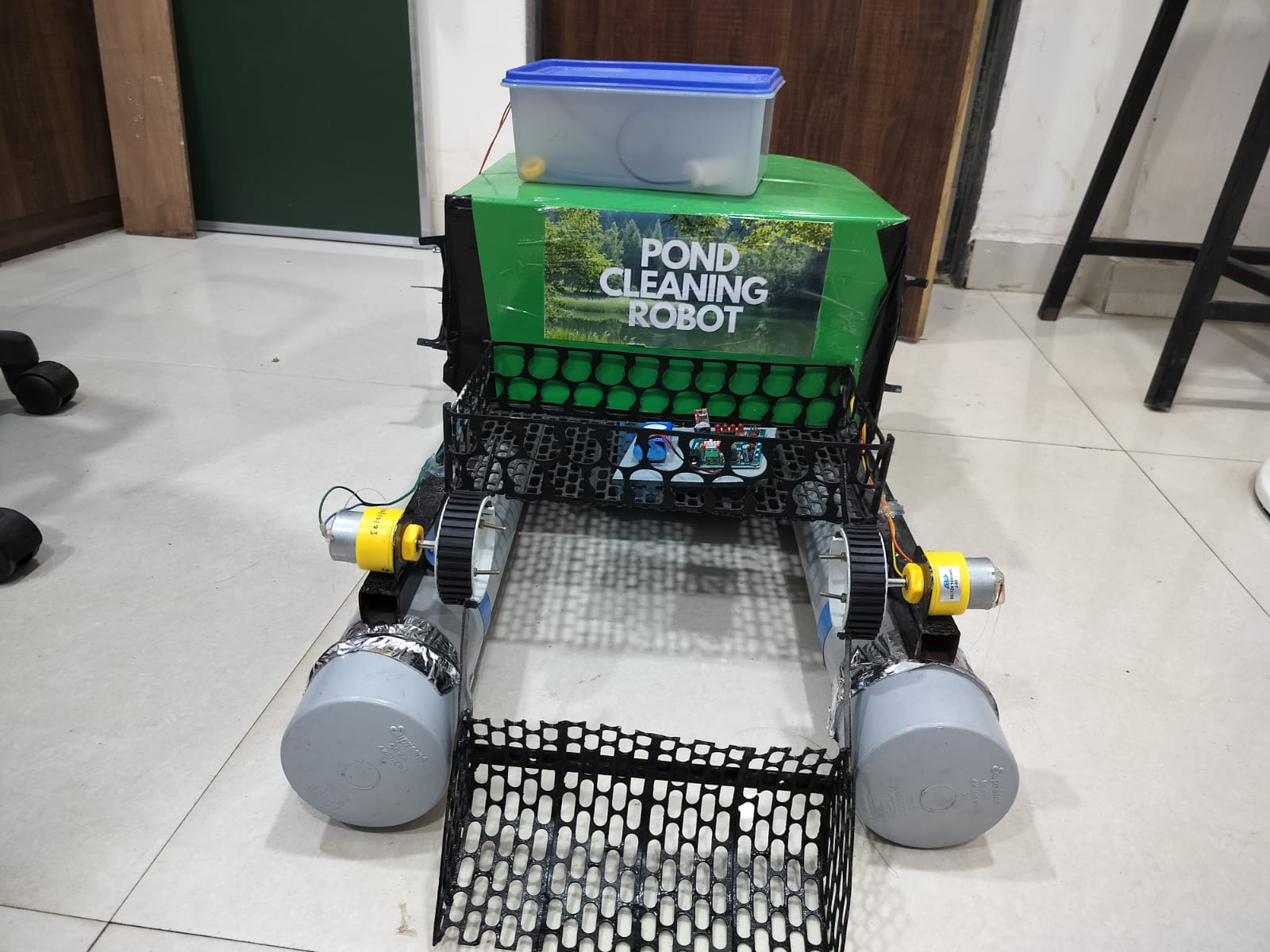
Remote Controlled Water Surface Cleaning Robot
Year: 2024
Overview
Kalinga University, Raipur, recognizes the importance of flexible working arrangements in promoting sustainability, employee well-being, and efficient resource utilization. In alignment with United Nations Sustainable Development Goal 11 (Sustainable Cities and Communities), the University supports telecommuting, online working, and hybrid work practices for eligible academic and administrative activities wherever operationally feasible.
The University utilizes a robust digital ecosystem comprising Learning Management Systems (LMS), ERP, video conferencing platforms, email services, cloud-based collaboration tools, and digital document management systems, enabling faculty members and administrative staff to perform academic, administrative, and research-related responsibilities remotely whenever required.
Faculty members are encouraged to conduct online classes, virtual meetings, research supervision, academic mentoring, webinars, faculty development programmes (FDPs), workshops, conferences, and academic counselling through digital platforms. Administrative meetings, committee meetings, interviews, and training programmes are also conducted in hybrid or virtual mode whenever appropriate, reducing the need for physical travel.
The University permits work-from-home arrangements under specific circumstances, including official approval, emergency situations, public health advisories, academic breaks, or duties that can be effectively performed remotely. Such practices help reduce employee commuting, lower fuel consumption, minimize greenhouse gas emissions, and improve work-life balance.
Kalinga University also encourages the digital submission and processing of official documents, online communication, e-office practices, and paperless administration, further reducing unnecessary travel and supporting sustainable campus operations.
Through these flexible work practices and digital transformation initiatives, Kalinga University contributes to reducing its environmental footprint while enhancing institutional efficiency and supporting SDG 11: Sustainable Cities and Communities.


Year: 2024
Overview
Kalinga University, Raipur, is committed to providing a supportive and inclusive work environment by offering affordable on-campus residential accommodation for eligible employees. In alignment with United Nations Sustainable Development Goal 11 (Sustainable Cities and Communities), the University facilitates access to safe, secure, and affordable housing for faculty members and staff, helping to reduce commuting distances, improve work-life balance, and enhance overall well-being.
The University provides staff quarters and residential accommodation for eligible teaching and non-teaching employees within or adjacent to the campus, subject to availability and institutional policies. These residential facilities are offered at subsidized or affordable rates determined by the University, enabling employees to reside close to their workplace and reducing transportation costs and carbon emissions.
The residential facilities are equipped with essential amenities such as electricity, water supply, sanitation, internet connectivity, security services, parking, landscaped surroundings, and access to campus facilities. Employees residing on campus also have convenient access to the library, healthcare facilities, sports amenities, cafeterias, and recreational spaces, contributing to a healthy and sustainable living environment.
By providing affordable housing, Kalinga University supports sustainable campus development, promotes employee welfare, and minimizes the environmental impact associated with daily commuting. The initiative also strengthens the University's commitment to creating an inclusive and resilient campus community.
Through the provision of affordable residential facilities, Kalinga University contributes to SDG 11: Sustainable Cities and Communities by promoting sustainable living, reducing transportation-related emissions, and enhancing the quality of life of its employees.
Year: 2024
Overview
Kalinga University, Raipur, is committed to providing safe, affordable, and inclusive residential facilities for students to ensure equitable access to higher education and promote sustainable campus living. In alignment with United Nations Sustainable Development Goal 11 (Sustainable Cities and Communities), the University offers well-maintained on-campus hostels at affordable charges, enabling students from diverse socio-economic backgrounds and different regions of India to pursue their education in a secure and supportive environment.
The University provides separate boys' and girls' hostels with furnished rooms and essential amenities, including 24×7 security, Wi-Fi connectivity, electricity, purified drinking water, hygienic dining facilities, housekeeping, laundry services, recreational spaces, and medical assistance. The hostels are located within or near the academic campus, allowing students to walk to classrooms, laboratories, libraries, and other academic facilities, thereby reducing the need for daily transportation and supporting a low-carbon campus.
Kalinga University strives to keep hostel charges reasonable and affordable, with fee structures approved by the University administration. The residential facilities are designed to provide a comfortable living environment while minimizing commuting costs and promoting student well-being. The hostels also incorporate sustainable practices such as energy-efficient lighting, water conservation measures, waste segregation, green landscaping, and regular cleanliness drives, contributing to environmentally responsible campus operations.
The University further supports residential students through warden supervision, anti-ragging measures, counselling services, health care, indoor and outdoor recreational facilities, cultural activities, and academic support, creating an inclusive and vibrant campus community.
By providing affordable, safe, and sustainable student accommodation, Kalinga University enhances access to quality higher education, reduces transportation-related environmental impacts, and promotes sustainable campus living in support of SDG 11: Sustainable Cities and Communities.
Overview
Kalinga University, Raipur, is committed to creating a safe, accessible, and pedestrian-friendly campus that promotes sustainable mobility and enhances the well-being of students, faculty, staff, and visitors. In alignment with United Nations Sustainable Development Goal 11 (Sustainable Cities and Communities), the University prioritizes pedestrian movement within the campus by designing infrastructure that encourages walking as the primary mode of transportation.
The University campus features dedicated pedestrian pathways, landscaped walkways, paved footpaths, pedestrian crossings, and traffic-calming measures that enable safe movement between academic buildings, hostels, libraries, laboratories, administrative offices, cafeterias, sports facilities, and recreational areas. The campus layout minimizes dependence on motorized vehicles, making walking the most convenient and environmentally sustainable mode of travel.
Kalinga University has also adopted barrier-free infrastructure to ensure accessibility for persons with disabilities. Ramps, accessible pathways, handrails, tactile features (where applicable), and designated access routes enable inclusive mobility across the campus. Vehicle movement is regulated through designated roads and parking areas, ensuring that pedestrian safety remains a priority.
The University's green campus design, with tree-lined avenues, shaded walkways, landscaped gardens, seating areas, and open spaces, provides a comfortable environment for walking while contributing to improved air quality and campus aesthetics. Awareness programmes conducted through NSS, NCC, Eco Club, and student organizations further encourage students and staff to prefer walking over motorized transport for short-distance travel within the campus.
By prioritizing pedestrian access and integrating sustainable campus planning, Kalinga University promotes healthy lifestyles, reduces carbon emissions, improves road safety, and supports environmentally responsible mobility. These initiatives contribute directly to the achievement of SDG 11: Sustainable Cities and Communities.
Year: 2024
Overview
Kalinga University, Raipur, actively collaborates with local authorities, government departments, statutory bodies, and community organizations to support sustainable planning, infrastructure development, environmental conservation, and community welfare in alignment with United Nations Sustainable Development Goal 11 (Sustainable Cities and Communities). Situated in Naya Raipur (Atal Nagar)—India's first planned Greenfield Smart City—the University contributes to regional development through academic partnerships, community outreach, research, and capacity-building initiatives.
The University works with organizations such as the Nava Raipur Atal Nagar Development Authority (NRDA/NRANVP), Raipur Municipal Corporation, Government of Chhattisgarh, educational institutions, industries, and non-governmental organizations to organize awareness programmes, plantation drives, Swachh Bharat campaigns, environmental protection activities, road safety programmes, health camps, and community development initiatives. Faculty members and students participate in extension activities that promote sustainable urban development, environmental stewardship, and civic responsibility.
Through NSS, NCC, and various academic departments, Kalinga University conducts village adoption programmes, cleanliness drives, literacy campaigns, environmental awareness programmes, water conservation initiatives, and health awareness activities in nearby communities. These programmes contribute to improving the quality of life of local residents while strengthening collaboration between the University and local authorities.
The University also contributes to regional planning and development through research, consultancy, technical expertise, internships, and collaborative projects in areas such as environmental management, sustainable infrastructure, renewable energy, public health, smart technologies, and disaster resilience. Faculty experts participate in seminars, workshops, and stakeholder consultations organized by government agencies and professional bodies to support evidence-based planning and sustainable development.
Although housing development for local residents is the responsibility of government agencies and urban development authorities, Kalinga University supports the broader objective of affordable and sustainable communities by providing technical knowledge, skilled graduates, community outreach, and research that contribute to inclusive urban and regional development.
Through these collaborative efforts, Kalinga University strengthens partnerships with local authorities and promotes sustainable planning, environmental protection, and community development, thereby contributing to the achievement of SDG 11: Sustainable Cities and Communities.
Indicator: Work with local authorities to address planning issues and development, including ensuring that local residents are able to access affordable housing.
Response: Yes
Collaboration with Local Authorities for Sustainable Planning and Community Development
Kalinga University, Raipur, actively collaborates with local government agencies, statutory bodies, industries, and community organizations to support sustainable regional development, infrastructure planning, environmental conservation, and community welfare. As part of its commitment to SDG 11 – Sustainable Cities and Communities, the University works with various stakeholders to promote inclusive urban and rural development through education, research, outreach programmes, and technical expertise.
Being located in Naya Raipur (Atal Nagar), the University maintains close interaction with government departments, local administration, municipal authorities, and development agencies for implementing community development initiatives, environmental awareness programmes, health camps, sanitation drives, plantation activities, road safety campaigns, and village adoption programmes through its National Service Scheme (NSS), National Cadet Corps (NCC), Unnat Bharat Abhiyan (UBA), and Institutional Social Responsibility (ISR) initiatives.
The University also contributes technical knowledge through faculty expertise, student projects, consultancy, and research collaborations that support sustainable infrastructure, environmental management, renewable energy, water conservation, waste management, and rural development.
Key Areas of Collaboration
1. Community Development through Government Partnerships
Kalinga University collaborates with local authorities and government departments to organize programmes on:
These activities strengthen the University's engagement with neighbouring communities while supporting local development priorities.
2. Participation in Regional Planning and Sustainable Development
Through academic expertise and institutional collaborations, the University supports regional planning by:
3. Collaboration for Housing and Inclusive Community Development
Although Kalinga University is not a housing development authority, it contributes to inclusive community development by:
These initiatives indirectly contribute to creating resilient and inclusive communities, consistent with the objectives of SDG 11.
4. Student and Faculty Engagement
Faculty members and students regularly participate in outreach activities through:
These programmes strengthen collaboration between the University and local authorities while encouraging students to contribute to sustainable community development.
Contribution to SDG 11
Through its partnerships with government agencies, local authorities, industries, and community organizations, Kalinga University contributes to:
Commitment to Sustainable Infrastructure Development
Kalinga University, Raipur, is committed to developing a sustainable, environmentally responsible, and future-ready campus by integrating green infrastructure and resource-efficient practices into the planning, design, construction, and operation of its academic and administrative facilities. The University recognizes that sustainable infrastructure plays a vital role in achieving Sustainable Development Goal 11 (Sustainable Cities and Communities) and therefore incorporates environmental considerations into all major infrastructure development projects.
Located in Naya Raipur (Atal Nagar), Chhattisgarh, the University has developed its campus with emphasis on environmental sustainability, energy conservation, water management, green landscaping, and efficient utilization of natural resources. The campus master planning focuses on creating an eco-friendly learning environment that supports quality education while minimizing environmental impacts.
Kalinga University continuously upgrades its infrastructure to provide modern teaching-learning facilities, research laboratories, innovation centres, hostels, sports facilities, and community spaces while incorporating sustainable construction practices and environmentally responsible campus management.
Adoption of Sustainable Building Practices
While Kalinga University is continuously strengthening its green campus initiatives, the University adopts sustainable design principles consistent with nationally accepted green building concepts such as those promoted by GRIHA (Green Rating for Integrated Habitat Assessment), IGBC (Indian Green Building Council), the Energy Conservation Building Code (ECBC), and the guidelines issued by the Bureau of Energy Efficiency (BEE) wherever applicable.
During the planning and construction of new academic blocks, laboratories, hostels, administrative buildings, and research facilities, emphasis is placed on:
These initiatives reflect the University's long-term commitment to sustainable campus development and responsible infrastructure planning.
Key Sustainable Design and Construction Features
1. Energy Efficiency and Renewable Energy Integration
Kalinga University promotes energy-efficient campus infrastructure through:
2. Water Conservation and Sustainable Water Management
The University has implemented several measures for efficient water utilization, including:
3. Sustainable Materials and Responsible Construction
Kalinga University encourages environmentally responsible construction by:
4. Green Campus Planning and Environmental Integration
The University's campus planning integrates infrastructure with environmental conservation through:
5. Healthy Indoor Environment
Kalinga University places emphasis on creating safe, comfortable, and healthy indoor environments by:
Indicator: Build on brownfield sites, where possible
Response: Currently not applicable; however, Kalinga University is committed to sustainable redevelopment and the optimal utilization of existing developed land wherever feasible.
Kalinga University, Raipur, was established on previously undeveloped land in Naya Raipur (Atal Nagar), Chhattisgarh, with the vision of creating a modern multidisciplinary institution equipped with world-class academic, research, healthcare, and innovation infrastructure. The campus was developed through a planned approach on land that was not previously occupied by industrial activities or urban infrastructure and therefore did not require brownfield remediation or environmental reclamation.
Since the site did not possess the characteristics of a brownfield area—such as abandoned industrial facilities, contaminated land, or obsolete urban infrastructure—the University's initial development focused on sustainable campus planning rather than redevelopment. This provided an opportunity to integrate environmentally responsible infrastructure, energy-efficient buildings, green landscaping, rainwater harvesting systems, renewable energy initiatives, and resource-efficient construction practices from the beginning.
As Kalinga University continues to expand its academic, research, innovation, and community engagement facilities, it recognizes the importance of sustainable land-use planning by maximizing the utilization of existing infrastructure and redeveloping underutilized campus spaces wherever possible before considering additional land expansion. This approach aligns with the University's commitment to sustainable campus development and responsible land management.
The University envisions future campus growth through the revitalization and adaptive reuse of existing built spaces, promoting efficient land utilization, environmental conservation, and long-term sustainability in accordance with the objectives of SDG 11: Sustainable Cities and Communities.
Future Vision and Strategic Initiatives
1. Sustainable Redevelopment of Existing Campus Infrastructure
Kalinga University intends to prioritize the redevelopment and adaptive reuse of underutilized buildings, vacant institutional spaces, and obsolete infrastructure within the existing campus before undertaking new construction. Future redevelopment projects will incorporate green building principles, energy-efficient technologies, and environmentally sustainable construction practices.
2. Efficient Land Utilization and Conservation
The University is committed to optimizing the use of available campus land by promoting vertical expansion, multifunctional academic spaces, and redevelopment of existing facilities wherever feasible. This strategy minimizes unnecessary greenfield expansion while preserving open spaces, biodiversity, and landscaped areas across the campus.
3. Campus Revitalization and Smart Infrastructure Development
Future infrastructure planning will focus on modernizing existing facilities through renovation, technological upgrades, improved accessibility, and smart campus solutions. Redevelopment initiatives will enhance the learning environment while creating safer, more inclusive, and environmentally sustainable spaces for students, faculty, staff, and visitors.
4. Environmental Sustainability and Regulatory Compliance
All future redevelopment and renovation activities will comply with applicable environmental regulations, green building guidelines, and sustainable construction standards. Kalinga University will continue to promote waste minimization, recycling of construction materials, energy conservation, water-efficient infrastructure, and environmentally responsible resource management, thereby contributing to SDG 11 (Sustainable Cities and Communities) and SDG 12 (Responsible Consumption and Production).