SDG 17: Partnerships for the Goals Report

Loading
Admissions Closing Soon for 2026-27
Apply NowKalinga University is committed to fostering sustainable development through strategic partnerships that strengthen institutional capacity, promote innovation, and create meaningful societal impact. In alignment with Sustainable Development Goal (SDG) 17: Partnerships for the Goals, the University collaborates with national and international academic institutions, industries, government agencies, professional bodies, research organizations, non-governmental organizations, and local communities. These collaborations facilitate the exchange of knowledge, research expertise, technology, and best practices while contributing to the achievement of several interconnected Sustainable Development Goals.

SDG 17 Related Publications (2024-25)
Cumulative SDG 17 Related Publications
National Signed MoUs
NGO MoUs
17.2.3 International Collaboration (2024-25)
Total Activities Conducted during 2024-25
SDG 17 aligned Activities
Major Activities & Community Engagement Initiatives
Kalinga University has emerged as a key regional stakeholder in SDG-led development by establishing strong and sustained collaborative relationships with NGOs, civil society organizations, and government agencies. These partnerships facilitate the translation of academic knowledge and research into practical, community-oriented interventions while contributing to local development priorities and policy frameworks.
During 2024–25, the University collaborated with various organizations and institutions working in the areas of sustainable development, social welfare, education, healthcare, environmental conservation, and community development, such as New Gurukul Education Society (NGES), Wilson College, Council of Teachers Professional Development (CTPD, Central Ground Water Board (CGWB), North Central Chhattisgarh Region Dumartarai Raipur, CAD Institute etc. . These collaborations strengthened the University's engagement with local communities and enabled the implementation of initiatives aligned with the Sustainable Development Goals (SDGs).
The partnerships advanced policy-relevant and community-focused interventions in areas including environmental restoration, gender equality, mental and physical health, educational inclusivity, livelihood enhancement, and community resilience. Through these engagements, the University not only facilitated awareness generation, capacity building, and skill development but also gathered valuable field-level insights and community feedback. These experiences contribute to evidence-based approaches for addressing local challenges and support the formulation and implementation of locally relevant SDG strategies and development interventions.
Website Link : https://kalingauniversity.ac.in/sustainability#mous
MoU List:
| Sl. No. | Names of Organizations with Signed MoUs | Year |
|---|---|---|
| 1 | UNIVERSITY COLLEGE OF PHYSICAL EDUCATION, OSMANIA UNIVERSITY - HYDERABAD T.S. - 07 | 2023 |
| 2 | D.P. VIPRA COLLEGE OF EDUCATION | 2023 |
| 3 | AMBALIKA INSTITUTE OF MANAGEMENT AND TECHNOLOGY | 2024 |
| 4 | MOU : FACULTY OF BUSINESS AND ECONOMICS MENDEL UNIVERSITY IN BRNO, CZECHIA | 2024 |
| 5 | AIPH UNIVERSITY KHORDHA, BHUBANESWAR, ODISHA - 752050 | 2024 |
| 6 | MAHATMA GANDHI UDYANIKEE & VANIKEE VISHWAVIDYALAYA | 2024 |
| 7 | GOVERNMENT COLLEGE OF EDUCATION, RAIPUR, CHHATTISGARH | 2024 |
| 8 | SAGE UNIVERSITY INDORE CAMPUS | 2024 |
| 9 | SANJAY MEMORIAL INSTITUTE OF ACADEMIC COORPERATION | 2024 |
| 10 | VISHVESHWARYA GROUP OF INSTITUTIONS | 2024 |
| 11 | THE PROGRESS (AN INITIATIVE OF SRI AUROBINDO YOGA & KNOWLEDGE FOUNDATION, INDIA) | 2024 |
| 12 | ICFAI UNIVERSITY | 2024 |
| 13 | MAHARSHI SCHOOL OF SCIENCE & HUMANITIES | 2024 |
| 14 | PRACYVA CONSULTING SERVICE PVT. LTD. | 2024 |
| 15 | SARDAR BHAGWAN SINGH UNIVERSITY | 2024 |
| 16 | PUNE INSTITUTE OF BUSINESS MANAGEMENT, MAHARASHTRA | 2024 |
| 17 | FORENSIBUS | 2024 |
| 18 | CODE F SOLUTIONS PVT. LTD. | 2024 |
| 19 | INDIAN NATIONAL BAR ASSOCIATION, NEW DELHI | 2024 |
| 20 | BHAKT MATA KARMA COLLEGE SAMODA RAIPUR | 2024 |
| 21 | KIPM-COLLEGE OF ENGINEERING & TECHNOLOGY. | 2024 |
| 22 | HIDAYATULLAH NATIONAL LAW UNIVERSITY (HNLU) | 2024 |
| 23 | SOCIETY OF INDIAN LAW FIRMS (SILF) | 2024 |
| 24 | SUNIL PATODIA WELFARE FOUNDATION | 2024 |
| 25 | GALMAX TECHNOLOGIES PVT. LTD. | 2024 |
| 26 | GOVT. RAJMOHINI DEVI GIRLS' P.G. COLLEGE | 2024 |
| 27 | GOVT. D.S.V. POST GRADUATE SANSKRIT COLLEGE | 2024 |
| 28 | NEW DELHI INSTITUTE OF MANAGEMENT, NEW DELHI | 2024 |
| 29 | CAREER POINT UNIVERSITY, KOTA RAJASTHAN | 2024 |
| 30 | CIT BED COLLEGE NAYA RAIPUR | 2024 |
| 31 | GOVT. GHANSHYAM SINGH GUPT P.GOLLEGE BALOD | 2024 |
| 32 | GIRNARSOFT EDUCATION SERVICES PRIVATE LIMITED | 2024 |
| 33 | JAIPURIA INSTITUTE OF MANAGEMENT INDORE | 2024 |
| 34 | NASSCOM /IT-ITES SECTOR SKILLS COUNCIL | 2024 |
| 35 | COLUMBIA COLLEGE TEKARI | 2024 |
| 36 | INSTITUTE OF ADVANCED STUDIES IN EDUCATION | 2024 |
| 37 | SYSTEM TWO SOLUTIONS PVT. LTD. (HEALTHPOTLI) | 2024 |
| 38 | ARM COLLEGE OF ENGINEERING AND TECHNOLOGY, SATTAMANGALAM | 2025 |
| 39 | LATE RAJA VIRENDRA BAHADUR SINGH GOVT. COLLEGE SARAIPALI | 2025 |
| 40 | NIILM UNIVERSITY | 2025 |
| 41 | THIRUVALLUVAR COLLEGE OF ENGINEERING AND TECHNOLOGY | 2025 |
| 42 | THIRUVALLUVAR ARTS AND SCIENCE COLLEGE | 2025 |
| 43 | GOVT. SHAHID VEER NARAYAN SINGH COLLEGE BILAIGARH | 2025 |
| 44 | KOPALVANI CHILD WALFARE ORGANIZATION RAIPUR C.G. | 2025 |
| 45 | PHARMACY COLLEGE AZAMGRH | 2025 |
| 46 | THE PHARMACEUTICAL COLLEGE, BARPALI, ODISHA | 2025 |
| 47 | ASSOCIATION OF MULTI SKILLED PROFESSIONALS, BHILAI | 2025 |
| 48 | JUSTAUTO SOLUTIONS PRIVATE LIMITED | 2025 |
| 49 | SRI SRI NRUSINGHNATH AYURVED COLLEGE AND RESEARCH INSTITUTE | 2025 |
| 50 | RITEE COLLEGE OF PHARMACY, RAIPUR (CHHATTISGARH) | 2025 |
Records 1–50 of 56
Collaborative Activities Undertaken
The University has undertaken a wide range of collaborative activities with NGOs, civil society organizations, government agencies, academic institutions, and other stakeholders to promote sustainable development and address community needs. These activities include joint awareness programmes, capacity-building and skill-development initiatives, community outreach programmes, environmental conservation and restoration activities, health and wellness camps, educational and social inclusion initiatives, livelihood enhancement programmes, research collaborations, training workshops, seminars, conferences, and knowledge-exchange programmes.
University-Led Initiatives on Sustainable Communities & Partnerships through Collaborative Programs


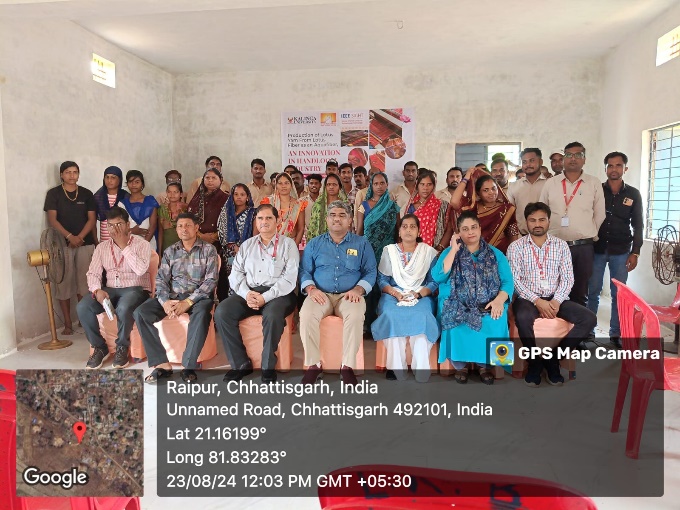
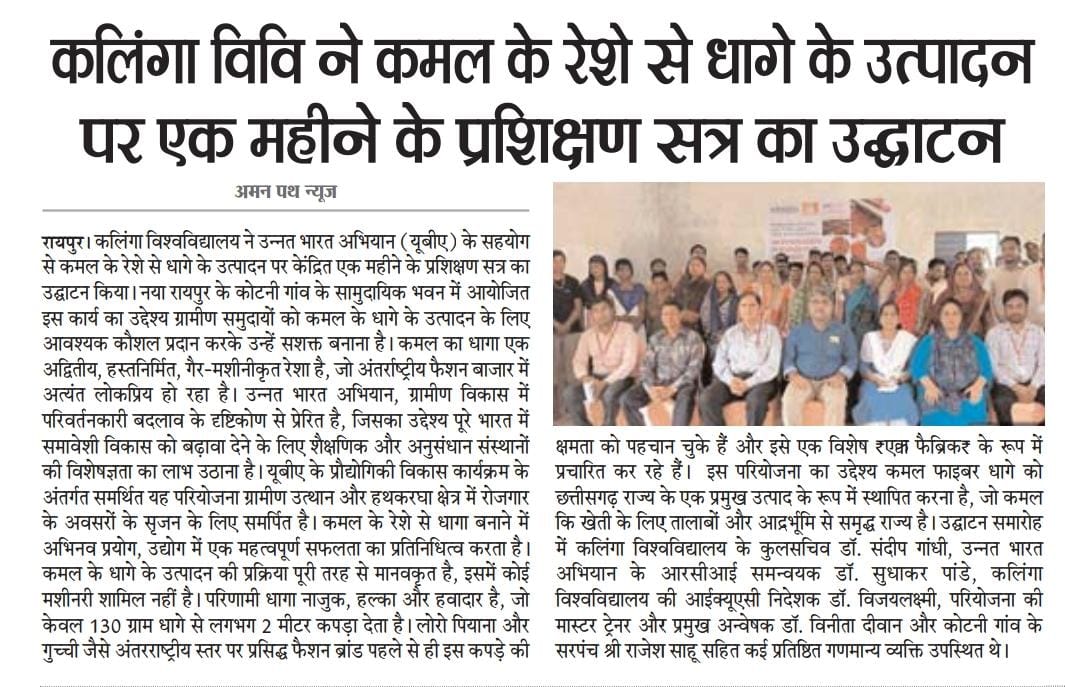

Community Outreach Programs & Events fostering awareness, social responsibility, sustainability, and community empowerment through meaningful student and faculty engagement.
Kalinga University strengthens its commitment to Sustainable Development Goal 17 (SDG 17): Partnerships for the Goals by developing and nurturing meaningful, long-term collaborations with a diverse range of stakeholders, including academic and research institutions, industries, government departments and agencies, non-governmental organizations (NGOs), civil society organizations, professional bodies, schools, and local communities. These partnerships provide a collaborative platform for addressing complex social, economic, environmental, and developmental challenges through shared knowledge, expertise, resources, and innovative solutions.
The University facilitates institutional and stakeholder partnerships through Memoranda of Understanding (MoUs), collaborative research projects, joint publications, conferences, seminars, workshops, training and capacity-building programmes, internships, community outreach initiatives, awareness campaigns, consultancy, knowledge-exchange programmes, and skill-development activities. Such collaborations enable the exchange of academic knowledge, technological expertise, infrastructure, human resources, and best practices, thereby strengthening institutional capacity and creating opportunities for impactful and sustainable interventions. Kalinga University places particular emphasis on cross-sectoral, multidisciplinary, and interdisciplinary collaboration. Faculty members, researchers, students, policymakers, legal professionals, industry experts, government representatives, development organizations, social-sector practitioners, and community stakeholders are brought together to share perspectives and develop context-specific solutions. This collaborative approach encourages the integration of academic research with practical field-level knowledge and helps bridge the gap between research, policy, industry requirements, and community needs.
The University's partnerships contribute to initiatives across several key development areas, including quality education, healthcare and well-being, environmental sustainability, climate action, skill development, entrepreneurship, livelihood enhancement, social inclusion, gender equality, community development, and capacity building. Through outreach and engagement with local communities, the University supports the identification of grassroots challenges and facilitates interventions that are responsive to local priorities and developmental requirements. Partnerships with government bodies, NGOs, civil society organizations, educational institutions, industries, and community organizations also provide opportunities for students and faculty to participate in real-world projects, field studies, awareness programmes, training initiatives, and community-based research. These engagements strengthen experiential learning, social responsibility, employability, and civic participation while enabling stakeholders to benefit from the University's academic and technical expertise.
The University further promotes knowledge sharing and evidence-based decision-making by disseminating research findings, good practices, technical knowledge, and field-level insights through academic events, publications, workshops, conferences, training programmes, and stakeholder consultations. Collaborative research and community engagement generate practical evidence that can support the development and implementation of effective programmes and policies aligned with the Sustainable Development Goals. Through these sustained partnerships, Kalinga University seeks to translate academic knowledge and institutional capabilities into actionable solutions that address real-world challenges. The University's collaborative ecosystem strengthens linkages between academia and society while creating opportunities for shared innovation, capacity development, resource mobilization, and sustainable impact.
By serving as a regional platform for collaboration, knowledge exchange, and sustainable development, Kalinga University contributes to strengthening local and regional capacities for SDG implementation. Its partnership-driven approach reflects the fundamental principle of SDG 17 that achieving the Sustainable Development Goals requires collective action, shared responsibility, mutual learning, and sustained cooperation among diverse stakeholders.
Overall, Kalinga University's initiatives under SDG 17 demonstrate its commitment to building inclusive, accountable, and mutually beneficial partnerships that support sustainable development, strengthen institutional and community capacities, and contribute to measurable progress towards the broader 2030 Agenda for Sustainable Development.
Key Cross-Sectoral Partnerships and Collaborative Initiatives
Conferences, Research Forums and Knowledge Exchange:
3rd IEEE World Conference on Communication and Computing (IEEE WCONF 2025)
The 3rd IEEE World Conference on Communication and Computing (IEEE WCONF 2025) was organized from 25–27 July 2025 by the IEEE Kalinga University Student Branch, in collaboration with Geethanjali College of Engineering and Technology (GCET), New Delhi Institute of Management (NDIM), IEEE Computer Society, IEEE Women in Engineering (WIE), and IEEE Aerospace and Electronic Systems Society (AESS). Sponsored by ANRF, Government of India, and technically co-sponsored by the IEEE Madhya Pradesh Section, the conference provided a platform for knowledge exchange, interdisciplinary research, technological innovation, and academia–industry collaboration. The event contributed to SDGs 4, 8, 9, 16 and 17 by promoting quality education, research and innovation, skill development, responsible institutions, and multi-stakeholder partnerships.
3rd IEEE World Conference on Communication and Computing (IEEE WCONF 2025) 25–27 July 2025


Global Conference on Cyber Violence and Digital Deception
The Global Conference on “Cyber Violence and Digital Deception: Understanding, Preventing and Responding to Technology-Facilitated Crimes” was organized by the Faculty of Law, Kalinga University, on 20–21 November 2025. The conference provided a multidisciplinary platform for legal experts, academics, researchers, policymakers, and other stakeholders to discuss emerging challenges related to cyber violence, digital deception, and technology-facilitated crimes. The event promoted knowledge sharing, digital awareness, research collaboration, and responsible technology use, contributing to SDGs 4, 9, 16, and 17 through quality education, technological innovation, stronger institutions, and multi-stakeholder partnerships.


Global Conference on “Cyber Violence and Digital Deception: Understanding, Preventing and Responding to Technology-Facilitated Crimes” , 20–21 November 2025
International Conference – SciSustain 2025
The International Conference “SciSustain 2025: Fostering Sustainable Development Through Interdisciplinary Scientific Research” was organized on 17–18 September 2025 at Kalinga University. The conference brought together researchers, academicians, industry professionals, and other stakeholders to exchange knowledge and explore interdisciplinary scientific approaches to sustainable development. It provided a platform for collaborative research, innovation, and knowledge sharing focused on addressing contemporary environmental, social, and technological challenges. The conference strengthened cross-disciplinary and multi-stakeholder partnerships and contributed to the University's commitment to the Sustainable Development Goals (SDGs), particularly through research-driven solutions and collaborative action.
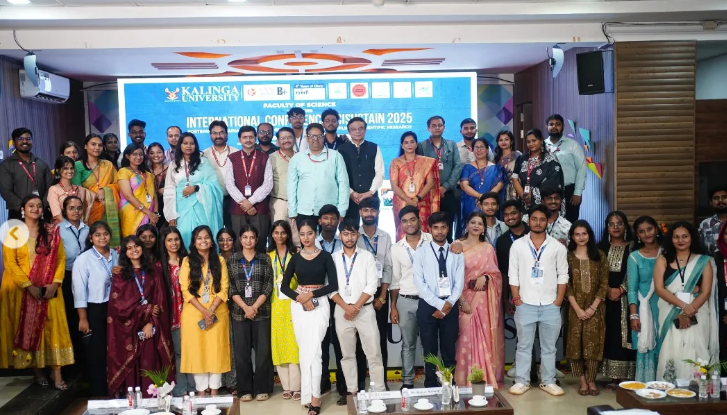
International Conference “SciSustain 2025: Fostering Sustainable Development Through Interdisciplinary Scientific Research, 17–18 September 2025
Model/Poster Exhibition on World Mental Health Day
The Model/Poster Exhibition on World Mental Health Day was organized by the Department of Social Work, Kalinga University, on 10 October 2025. The exhibition used creative models and posters to promote awareness about mental health, emotional well-being, and social support. It encouraged students and the wider community to engage in dialogue on mental health and responsible social behaviour. The initiative contributed to SDGs 3, 4, 16, and 17 by promoting health and well-being, awareness and learning, inclusive and supportive communities, and stakeholder engagement through collaborative outreach.


Model/Poster Exhibition on World Mental Health Day, 10 October 2025
Guest Lecture on “Lean Startup & Minimum Viable Product (MVP) / Business Boot Camp & Mentoring Session”
The Faculty of Technology, in association with the Institutions Innovation Council (IIC), organized a guest lecture and mentoring session on “Lean Startup & Minimum Viable Product (MVP)” on 13 August 2025. The session focused on entrepreneurship, innovation, idea validation, and developing market-ready solutions. It encouraged students to transform innovative ideas into viable business models, fostering entrepreneurial skills, employability, innovation, and sustainable enterprise development, thereby contributing to SDG 8 (Decent Work and Economic Growth) and SDG 9 (Industry, Innovation and Infrastructure).


Guest Lecture and mentoring session on “Lean Startup & Minimum Viable Product (MVP)” on 13 August 2025.
“Guest Lecture on “Heat Transfer Through Finite Difference”
The Department of Mechanical Engineering, Faculty of Technology, organized a guest lecture on “Heat Transfer Through Finite Difference” on 21 August 2025. The session introduced students to numerical methods for analyzing heat transfer problems and their applications in engineering design and energy-efficient systems. The lecture promoted innovation, sustainable engineering practices, and efficient resource utilization, contributing to SDG 9 (Industry, Innovation and Infrastructure) and SDG 11 (Sustainable Cities and Communities).


“Heat Transfer Through Finite Difference” on 21 August 2025
Legal Awareness, Governance and Policy Dialogues:
76th Constitution Day Celebration: “Dignity Beyond Text: POSH as an Instrument to Enforce Article 14 & 15 of the Constitution of India”
The 76th Constitution Day Celebration was organized on 26 November 2025 by the Faculty of Law, Faculty of Education, and NSS, in association with the Legal Aid Cell. The programme focused on POSH (Prevention of Sexual Harassment) as an instrument for promoting dignity, equality, safety, and non-discrimination under Articles 14 and 15 of the Constitution of India. The initiative enhanced awareness of gender equality, inclusive education, safe workplaces, and access to justice, contributing to SDGs 3, 4, 5, 8, 10, and 16.


76th Constitution Day Celebration was organized on 26 November 2025
6 Days Online Certificate Course on “Legal Drafting and Contract Drafting”
6-day Online Certificate Course on “Legal Drafting and Contract Drafting” from 10 to 16.09.2025The Faculty of Law organized a 6-day Online Certificate Course on “Legal Drafting and Contract Drafting” from 10 to 16 September 2025. The course enhanced participants’ practical knowledge and skills in legal drafting, contract preparation, and professional legal practices. It promoted employability, professional development, innovation in legal services, access to justice, and collaborative learning, contributing to SDG 8 (Decent Work and Economic Growth), SDG 9 (Industry, Innovation and Infrastructure), SDG 16 (Peace, Justice and Strong Institutions), and SDG 17 (Partnerships for the Goals).
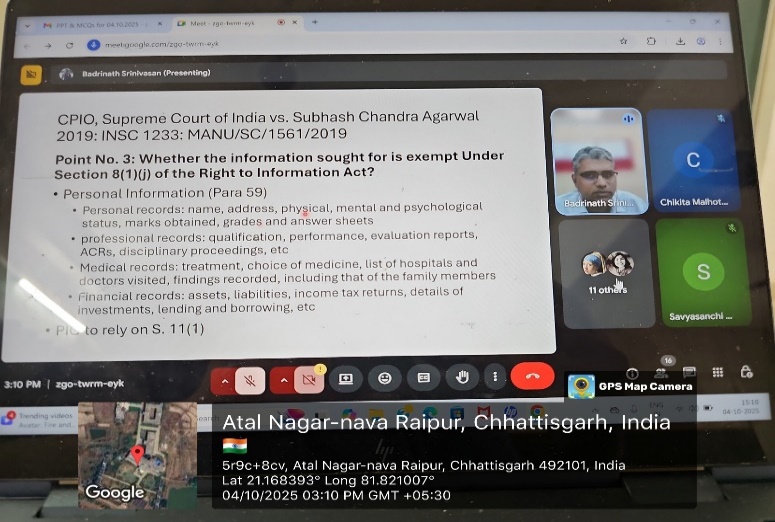

Trainers’ Training Certification Course on RTI Act, 2005
The Faculty of Law, Kalinga University, Naya Raipur organized a Trainers’ Training Certification Course on the Right to Information (RTI) Act, 2005 on 20 September, 27 September, 4 October, and 11 October 2025. The programme strengthened participants’ understanding of transparency, accountability, citizens’ rights, and access to information while developing their capacity to disseminate RTI awareness. The initiative promoted inclusive education, reduced inequalities, transparent institutions, and collaborative knowledge sharing, contributing to SDG 4, SDG 10, SDG 16, and SDG 17.


Trainers’ Training Certification Course on the Right to Information (RTI) Act, 2005 on 20 September, 27 September, 4 October and 11 October 2025
Legal Aid Activity on “Legal Awareness Regarding Domestic Safety & Avoidance of Violence”
The Faculty of Law organized a Legal Aid Activity on “Legal Awareness Regarding Domestic Safety & Avoidance of Violence” on 19 November 2025. The activity focused on creating awareness about legal rights, preventive measures, and available legal remedies related to domestic violence. It empowered participants with knowledge of gender equality, safety, dignity, and access to justice, contributing directly to SDG 5 (Gender Equality).


Legal Aid Activity on “Legal Awareness Regarding Domestic Safety & Avoidance of Violence” on 19 November 2025.
Surana & Surana Judex 3.0 Human Rights Law Moot Court Competition, 2025
The Surana & Surana Judex 3.0 Human Rights Law Moot Court Competition, 2025, organized by the Faculty of Law on 11–12 July 2025 (Online Rounds) and 1–2 August 2025 (On-Campus Rounds), provided students with a platform to develop legal research, advocacy, critical thinking, and professional communication skills. Focusing on human rights, equality, justice, and constitutional values, the competition promoted quality legal education and awareness of social justice issues. The initiative contributed to SDG 4 (Quality Education), SDG 5 (Gender Equality), SDG 10 (Reduced Inequalities), and SDG 16 (Peace, Justice and Strong Institutions) by encouraging students to understand and advocate for human rights, non-discrimination, equality, and access to justice.
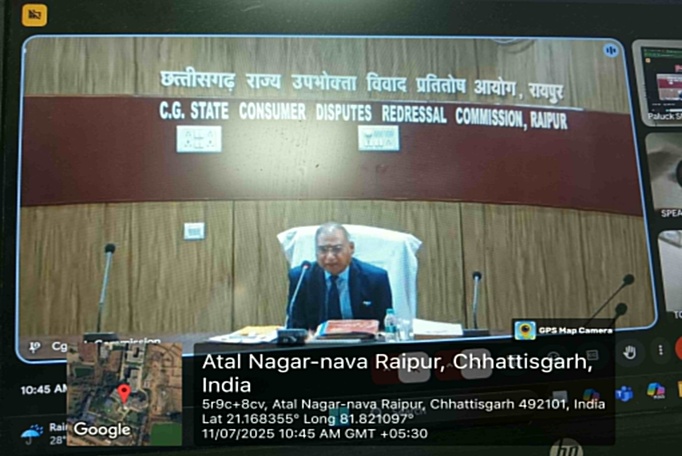
Surana & Surana Judex 3.0 Human Rights Law Moot Court Competition, 2025, organized by the Faculty of Law on 11–12 July 2025 (Online Rounds) and 1–2 August 2025 (On-Campus Rounds)

Community Engagement and Rural Development Initiatives:
Donation Drive: “Donate to Make a Difference”
The “Donation Drive: Donate to Make a Difference”, organized by the Faculty of Arts & Humanities under the Unnat Bharat Abhiyan on 8 November 2023 at Khapri Slum Area, near Balco Hospital, Naya Raipur, aimed to support economically vulnerable communities by providing essential resources and fostering a culture of compassion and social responsibility. The initiative encouraged students and faculty members to actively engage with the community and contribute towards improving the well-being and dignity of underserved populations. The activity supported SDG 1 (No Poverty), SDG 2 (Zero Hunger), SDG 10 (Reduced Inequalities), and SDG 17 (Partnerships for the Goals).


Donation Drive: Donate to Make a Difference”, organized by the Faculty of Arts & Humanities under the Unnat Bharat Abhiyan on 8 November 2023 at Khapri Slum Area, near Balco Hospital, Naya Raipur
Bhoomi Club Donation Drive – 2025
The Bhoomi Club Donation Drive, organized by the Bhoomi Club, Department of Social Work, on 16 October 2025, aimed to support underprivileged and economically vulnerable communities through the collection and distribution of essential resources. The initiative encouraged students to participate in community service, promoting empathy, social responsibility, and inclusive development. By addressing basic needs and supporting disadvantaged groups, the activity contributed to SDG 1 (No Poverty) and SDG 10 (Reduced Inequalities).
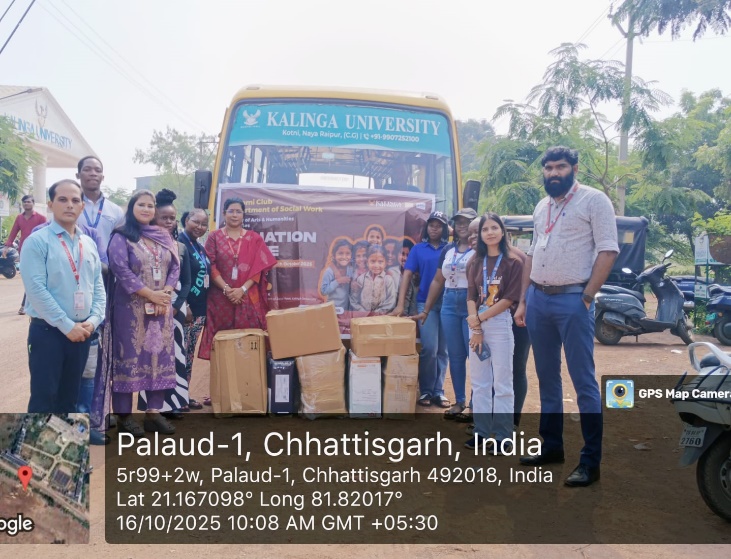


Bhoomi Club Donation Drive, organized by the Bhoomi Club, Department of Social Work, on 16 October 2025
Hindi Diwas Samaroh (12/09/2025)
The Hindi Diwas Samaroh promoted linguistic diversity, cultural heritage, and inclusive communication, supporting SDG 4 (Quality Education), SDG 10 (Reduced Inequalities), and SDG 16 (Peace, Justice and Strong Institutions).


Hindi Diwas Samaroh (12/09/2025), organized by Faculty of Arts & Humanities
National Seminar on “From Vachanas to Vision: Mahatma Basaveshwara’s Ideas in Contemporary Society” (25/08/2025):
The National Seminar examined Mahatma Basaveshwara’s progressive ideas and their relevance to contemporary society. It encouraged innovation, ethical leadership, social equality, inclusive development, and responsible citizenship, contributing to SDG 9 (Industry, Innovation and Infrastructure) and SDG 16 (Peace, Justice and Strong Institutions).


National Seminar on “From Vachanas to Vision: Mahatma Basaveshwara’s Ideas in Contemporary Society” (25/08/2025)
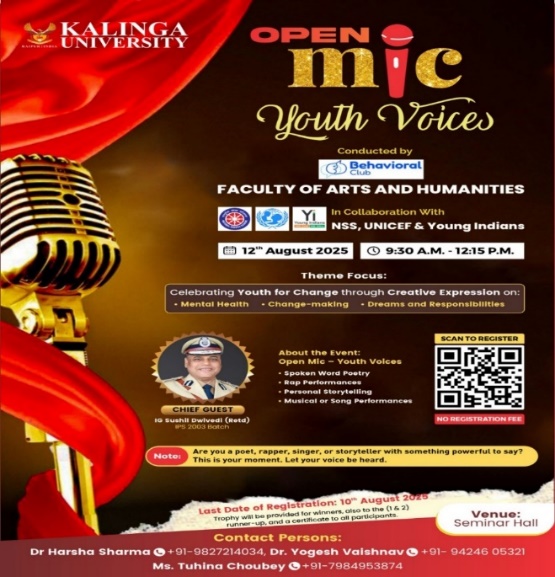
Open Mic: Youth Voices – “A Celebration of Youth Expression and Empowerment” (12/08/2025):
The event provided a platform for young people to express their ideas, creativity, opinions, and aspirations, fostering confidence, participation, and social awareness. Organized by the Behaviour Club, a UNICEF unit at Kalinga University, in association with Young Indians and NSS, it supported SDG 4, SDG 10, and SDG 16.

Open Mic: Youth Voices – “A Celebration of Youth Expression and Empowerment” (12/08/2025)
Tourism Treasure Hunt 2025 – “Incredible India and Chhattisgarh” (26/09/2025):
The Tourism Treasure Hunt 2025 celebrated World Tourism Day by enhancing students’ knowledge of India and Chhattisgarh’s cultural, historical, and geographical heritage. The activity promoted experiential learning, teamwork, responsible tourism, and active participation, contributing to SDG 4 (Quality Education) and SDG 16 (Peace, Justice and Strong Institutions).
Tourism Treasure Hunt 2025 – “Incredible India and Chhattisgarh” (26/09/2025)


Faculty Capacity Building, Development and Research Collaboration
Capacity Building Workshop on “Techniques of Forensic Evidences in Crime Scene Investigation and New Criminal Laws” (23/08/2025, 30/08/2025 & 06/09/2025)
The workshop enhanced participants’ knowledge of forensic evidence, crime scene investigation, and new criminal laws. It strengthened professional skills, legal awareness, interdisciplinary learning, equality, and institutional collaboration, contributing to SDG 4, SDG 10, SDG 16, and SDG 17 through capacity building and knowledge sharing.
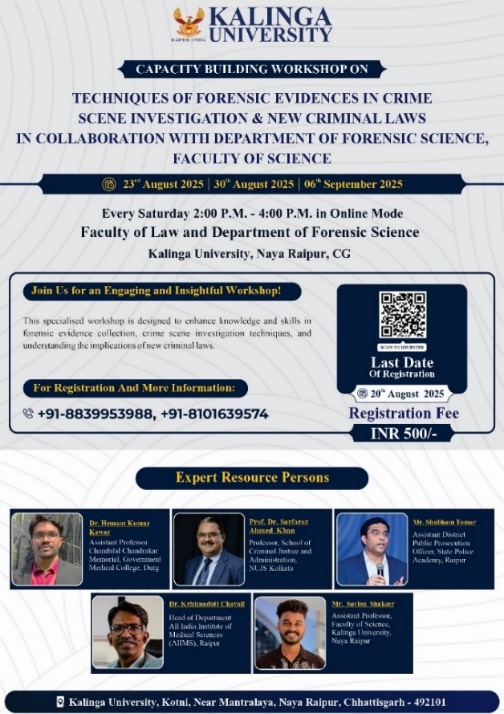
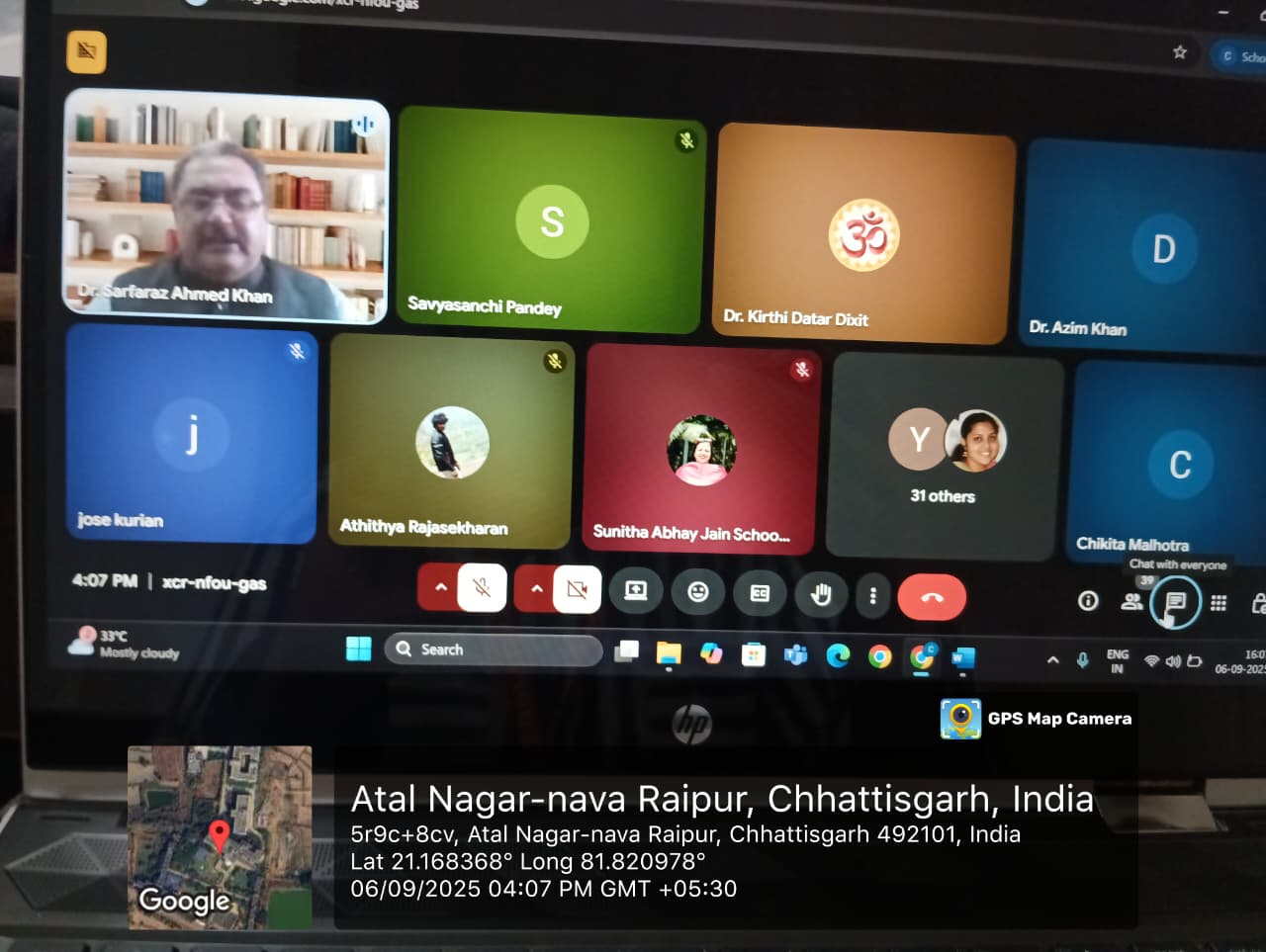
Capacity Building Workshop on “Techniques of Forensic Evidences in Crime Scene Investigation and New Criminal Laws” (23/08/2025, 30/08/2025 & 06/09/2025)
Two-Week Online Faculty Development Programme (FDP) on “Emerging Trends in Research and Innovative Teaching Pedagogy” (14–27 July 2025)
The FDP enhanced faculty competencies in contemporary research methodologies, emerging trends, and innovative teaching pedagogies. It promoted quality education, research-driven innovation, and academic collaboration through knowledge sharing and professional development, contributing to SDG 4 (Quality Education), SDG 9 (Industry, Innovation and Infrastructure), and SDG 17 (Partnerships for the Goals).
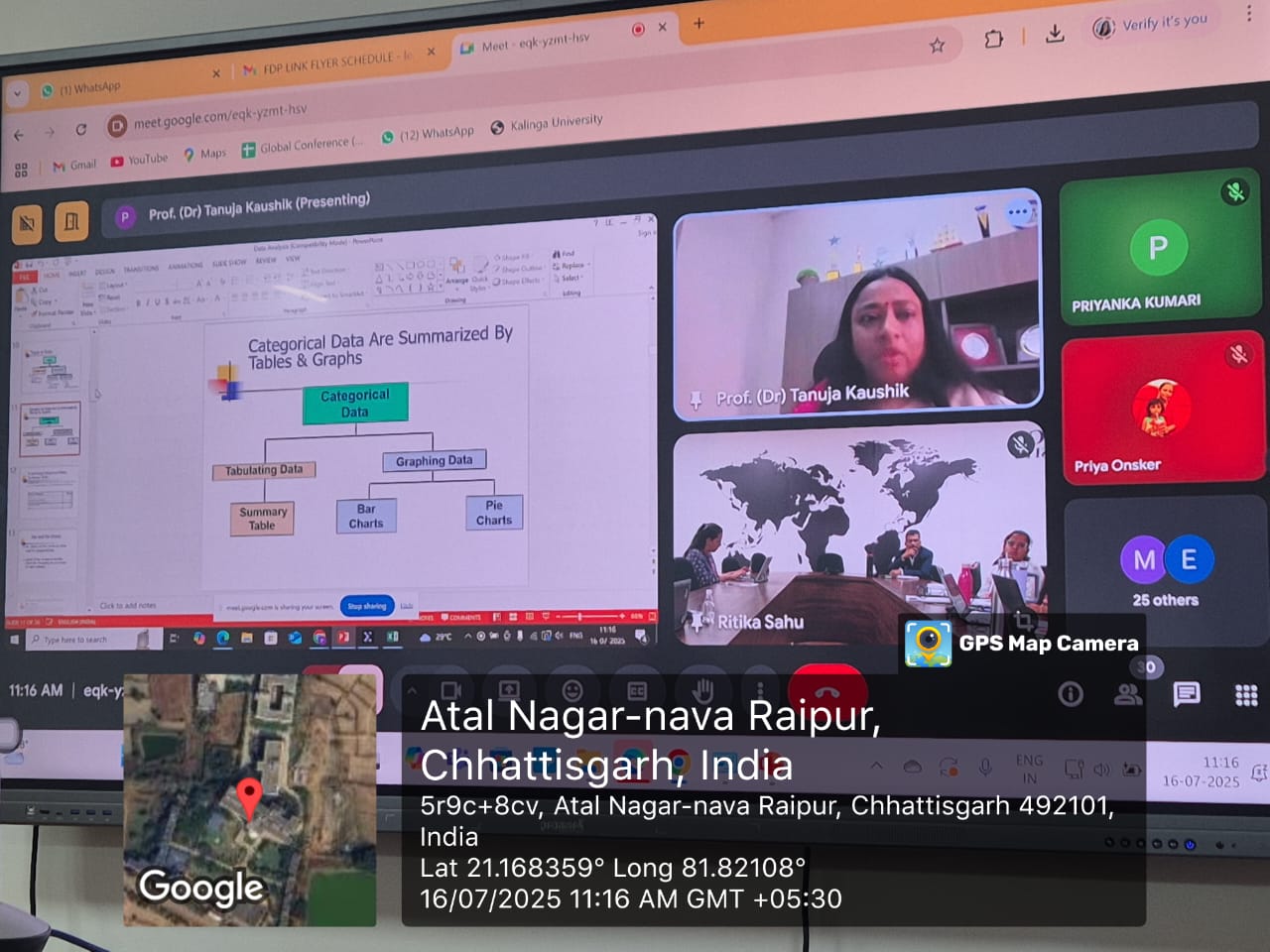

Two-Week Online Faculty Development Programme (FDP) on “Emerging Trends in Research and Innovative Teaching Pedagogy” (14–27 July 2025)
ATAL FDP (Offline) on “AR/VR/MR: Differences & Its Application Areas” (06–11 October 2025)The six-day AICTE-sponsored FDP enhanced participants’ understanding of Augmented, Virtual, and Mixed Reality technologies and their applications. With around 50 participants from across India, the programme promoted technological innovation, digital skills, knowledge exchange, and professional development, contributing to SDG 4, SDG 9, and SDG 17.

ATAL FDP (Offline) on “AR/VR/MR: Differences & Its Application Areas” (06–11 October 2025)

Kalinga University has strengthened its international engagement through collaborations with reputed universities, academic institutions, and global stakeholders. These partnerships facilitate academic interactions, expert talks, workshops, knowledge-sharing sessions, collaborative learning, and the exchange of best practices in areas such as employability, sustainability, economics, management, innovation, and cross-cultural competencies. Such initiatives provide students and faculty with valuable exposure to diverse educational systems, international perspectives, emerging industry trends, and global academic practices.
The University leverages these international engagements to identify, exchange, and benchmark good practices related to global education, skill development, sustainability models, inclusive learning, institutional governance, and innovation ecosystems. The knowledge and insights gained through these collaborations contribute to the continuous enhancement of curricula, teaching-learning methodologies, research activities, professional development, and student-centric initiatives in alignment with global standards and the United Nations Sustainable Development Goals (SDGs).
International collaborations further promote knowledge exchange in areas including graduate employability, sustainable rural development, ethical business practices, innovation, inclusive education, and responsible institutional practices. Through cross-border academic cooperation, Kalinga University creates opportunities for faculty and students to engage with international experts, share knowledge, and develop globally relevant competencies.
These initiatives demonstrate the University's commitment to internationalization, collaborative learning, and sustainable development in higher education. They particularly contribute to SDG 17 (Partnerships for the Goals) while supporting interconnected goals such as SDG 4 (Quality Education), SDG 8 (Decent Work and Economic Growth), SDG 9 (Industry, Innovation and Infrastructure), and SDG 10 (Reduced Inequalities).
International Partnerships and Collaborative Activities
Kalinga University demonstrates its commitment to Sustainable Development Goal 17 (SDG 17: Partnerships for the Goals) through regular engagement with international guests, academic representatives, and delegations from diverse countries. The visits recorded from Year 2022 to Year 2025 reflect the University’s efforts to strengthen international collaboration, academic networking, knowledge exchange, and institutional partnerships.
International guests and delegations from countries including Nigeria, Uganda, Zimbabwe, Rwanda, Namibia, Tanzania, Liberia, Eswatini, Nepal, and India have visited the University during this period. These interactions provided opportunities for meaningful discussions on higher education, academic programmes, research collaboration, student mobility, cultural exchange, capacity building, and potential institutional partnerships.
Such international engagement contributes directly to SDG 17 by creating platforms for collaboration among educational institutions, researchers, students, and international stakeholders. The visits also support the broader objectives of Education for Sustainable Development (ESD) by exposing the University community to diverse international perspectives and encouraging cross-cultural learning. These interactions can facilitate collaborative research, sharing of academic expertise, joint programmes, and development of long-term partnerships addressing common educational and societal challenges.
The international visits further demonstrate the University's role as a platform for global academic connectivity and knowledge sharing. Engagement with representatives from different geographical regions strengthens institutional networks and promotes mutual understanding, inclusivity, and cooperation.
Overall, the documented visits represent an important component of Kalinga University’s internationalisation initiatives and provide evidence of its continued efforts to build strong, inclusive, and sustainable global partnerships. Through these engagements, the University contributes to the achievement of SDG 17, while simultaneously supporting other SDGs through collaborative education, research, innovation, and community-oriented initiatives.
List of Visits by International Guests and Delegations
| S. No. | Date of Visit | Name of the International Guests | Name of the Country |
|---|---|---|---|
| 1 | 23.11.2025 | Dr. Hadi Bala | Kano, Nigeria |
| 2 | 18.07.2025 | Mr. Shaloom Niyomuvunyi | Rwanda |
| 3 | 18.07.2025 | Ms. Nkosingiphile Kunene | Eswatini |
| 4 | 09.07.2025 | Ssekikubo Ronald | Uganda |
| 5 | 06.04.2025 | Mr. Isaac Sskisambu | Uganda |
| 6 | 22.02.2024 | Mr. Randall Yeaney | Liberia |
| 7 | 29.01.2024 | Mr. Allan Khumbulani Masuku | Zimbabwe |
| 8 | 25.01.2024 | Mr. Uwambazimana Chaste Sauveur | Zimbabwe |
| 9 | 16.01.2024 | Mr. Trust Mukuruge | Uganda |
| 10 | 13.01.2024 | Mr. Sie Gregoire Hien | Uganda |
| 1 | 28.12.2023 | Mr. Tichafara Dube Tazvivinga | Tanzania |
| 12 | 21.12.2023 | Mr. Moses Asiimwe | Uganda |
| 13 | 08.12.2023 | Mr. Adonis Boly Druid | Rwanda |
| 14 | 22.11.2023 | Mr. Mohammed Lawan Nijwaji | Nigeria |
| 15 | 07.11.2023 | Mr. Ahmed Tijjani Umar | Nigeria |
| 16 | 29.09.2023 | Dr. Kabir | Nigeria |
| 17 | 27.07.2023 | Mr. Kwateng Samuel Owusu | Rwanda |
| 18 | 20.07.2023 | Mr. Gabriel Sinimbo | Namibia |
| 19 | 15.07.2023 | Mr. Paul Obengi | Zimbabwe |
| 20 | 27.01.2023 | Mr. Mahboob Khan | India |
| 21 | 27.08.2022 | Mr. Ankit Kumar Sah | Nepal |
| 2 | 04.06.2022 | Mr. Mukhtar Umar Bunza | Kebbi |
| 23 | 04.06.2022 | Mr. Mohammed Juzuli | Kebbi |
| 24 | 04.06.2022 | Mr. Mahboob Khan | Kebbi |
| 25 | 26.02.2022 | Mr. Ahmed Sule | Nigeria |
| 26 | 10.02.2022 | Ms. Halima Dikko | Kebbi |
| 27 | 10.02.2022 | Mrs. Jazuli Musa | Kebbi |
| 28 | 10.02.2022 | Mr. Mahboob Khan | Kebbi |
Glimpse of the Events & Reports:


International Guest Visit & Academic Interaction Session with Delegation from Kano, Nigeria, organized by Kalinga University in association with the Government of Kano, Nigeria, on 23rd November 2025.


International Guest Visit” organized by the International Students Cell, Kalinga University, on 25 January 2024.

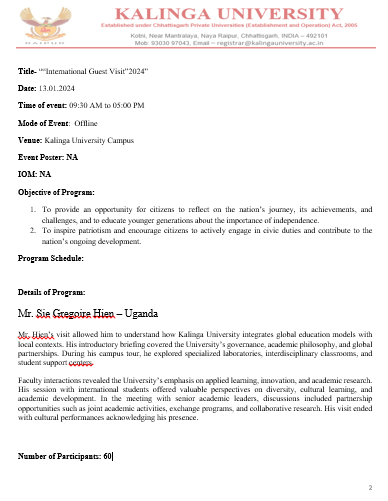


International Guest Visit” organized by the International Students Cell, Kalinga University, on 13 January 2024.

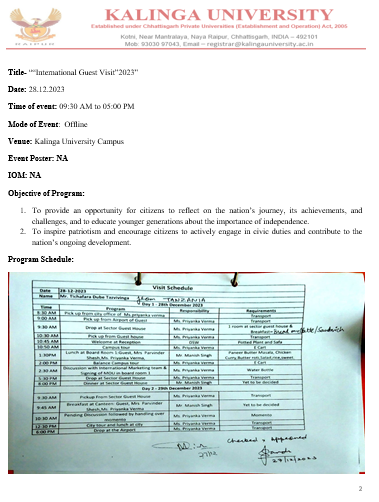


International Guest Visit” organized by the International Students Cell, Kalinga University, on 28 December 2023.


International Guest Visit” organized by the International Students Cell, Kalinga University, on 27 January 2023.


International Guest Visit” organized by the International Students Cell, Kalinga University, on 22 November 2023.


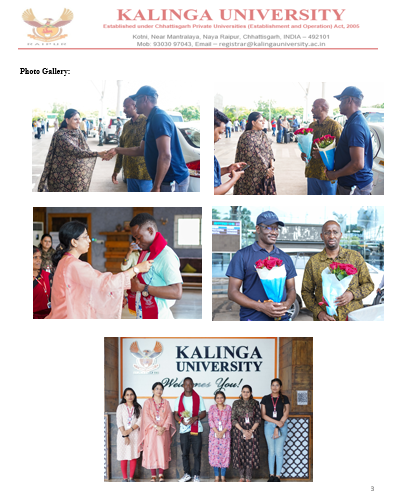

International Guest Visit” organized by the International Students Cell, Kalinga University, on 20 July 2023.


International Guest Visit” organized by the International Students Cell, Kalinga University, on 08 December 2023.

Kalinga University actively promotes international research collaboration to advance the United Nations Sustainable Development Goals (SDGs) through impactful research, academic partnerships, and global knowledge exchange. Up to year 2025, the University produced research articles involving international collaboration, demonstrating its strong commitment to global academic engagement and cross-border research partnerships.
These collaborations span 47 countries/regions, including Iraq, Uzbekistan, the United States, Saudi Arabia, Malaysia, the United Arab Emirates, Jordan, Canada, Taiwan, Indonesia, Lebanon, Ethiopia, South Korea, China, Australia, Viet Nam, the United Kingdom, France, Pakistan, Japan, and several other countries. The highest levels of collaboration were recorded with Iraq (396 research articles) and Uzbekistan (308 research articles), followed by the United States (35), Saudi Arabia (12), and Malaysia (11). This diverse international network reflects the University's growing global research footprint and its ability to connect researchers across different geographical and academic contexts.
Internationally collaborative research contributes to addressing global challenges related to quality education, clean energy, sustainable cities, responsible consumption, innovation, economic development, environmental sustainability, and inclusive societies. These partnerships facilitate the exchange of knowledge, expertise, research methodologies, resources, and innovative practices.
Through joint research, academic interactions, conferences, workshops, and knowledge-sharing initiatives, Kalinga University continues to strengthen its international research ecosystem. These efforts particularly support SDG 17 (Partnerships for the Goals) while contributing to other interconnected SDGs through collaborative research and innovation. The University's expanding international research network demonstrates its commitment to strengthening global partnerships and contributing to evidence-based solutions for sustainable development.
Website Link : https://kalingauniversity.ac.in/sustainability#mous
List of International MoUs and Collaborative Initiatives
| Sl. No. | Name of Institute / Organisation | Date of MoU | Location | Country | Type of Partnership |
|---|---|---|---|---|---|
| 1 | SHAHEED PROF. RABBANI EDUCATION UNIVERSITY | 07.04.2018 | AFGHANISTAN | AFGHANISTAN | INSTITUTION |
| 2 | ACADEMY OF JOURNALISM AND COMMUNICATION, HANOI | 10.05.2018 | HANOI | VIETNAM | INSTITUTION |
| 3 | SPRAN INTERNATIONAL PTE LTD | 03.07.2018 | SINGAPORE | MALAYSIA | CORPORATE |
| 4 | DEUDRAA UK LIMITED | 08.08.2018 | ILFORD - UK | UNITED KINGDOM | ACADEMIC |
| 5 | P PROPERTY HOLDINGS LIMITED | 22.10.2018 | BASILDON, ENGLAND | UNITED KINGDOM | CORPORATE |
| 6 | HEWAD UNIVERSITY | 06.11.2018 | KABUL | AFGHANISTAN | INSTITUTION |
| 7 | LINKUP PROPERTY DEVELOPMENT LIMITED | 17.12.2018 | ILFORD - UK | UNITED KINGDOM | CORPORATE |
| 8 | TRIBHUVAN UNIVERSITY - KIRTIPUR | 03.02.2019 | KATHMANDU | NEPAL | INSTITUTION |
| 9 | KINGSMEAD BUSINESS SOLUTION LIMITED | 13.03.2019 | UNITED KINGDOM | UNITED KINGDOM | CORPORATE |
| 10 | L'UNIVERSITE KOFI ANNAN DE | 25.03.2019 | GUINEE | GUINEE | INSTITUTION |
| 1 | UNIVERSITE NANGO CONAKRY | 25.03.2019 | CONAKRY | GUINEE | INSTITUTION |
| 12 | NO PLACE LIMITED | 27.03.2019 | ILFORD - UK | UNITED KINGDOM | CORPORATE |
| 13 | OREDIAN EDUCATION RESOURCES LIMITED | 12.04.2019 | NIGERIA | NIGERIA | ACADEMIC |
| 14 | INTERNATIONAL MIND EDUCATION INSTITUTE | 19.09.2019 | SOUTH KOREA | SOUTH KOREA | INSTITUTION |
| 15 | SPRAN INTERNATIONAL PTE LTD | 27.08.2021 | SINGAPORE | SINGAPORE | ACADEMIC |
| 16 | AL-SHAMAL PRIVATE UNIVERSITY | 13.08.2022 | SARMADA | SYRIA | INSTITUTION |
| 17 | WESTFORD EDUCATION GROUP | 08.09.2022 | LONDON - UK | UNITED KINGDOM | INSTITUTION |
| 18 | GBARPOLU COUNTY EDUCATION SCHOOL SYSTEM | 22.08.2023 | GBARPOLU - LIBERIA | LIBERIA | INSTITUTION |
| 19 | AMOU : FACULTY OF BUSINESS AND ECONOMICS MENDEL UNIVERSITY IN BRNO, CZECHIA | 11.01.2024 | BRNO, CZECHIA | MORAVIA | INSTITUTION |
| 20 | PRACYVA CONSULTING SERVICE PVT. LTD. | 17.06.2024 | LONDON - UK | UK | ACADEMIC |
| 21 | HEBEI INTERNATIONAL STUDIES UNIVERSITY | 27.03.2026 | HEBEI | CHINA | INSTITUTION |
Kalinga University actively engages students through its National Service Scheme (NSS) and Young Indians (YI) units to promote the United Nations Sustainable Development Goals (SDGs) and strengthen community engagement. These platforms encourage students to develop civic responsibility, leadership, empathy, teamwork, and humanitarian values while actively participating in community-oriented initiatives.
Through NSS and YI, students undertake awareness campaigns, health and wellness activities, social outreach programmes, community service, educational initiatives, and capacity-building activities in collaboration with NGOs, government agencies, community organizations, and other stakeholders. These partnerships enable students to address local and societal challenges while gaining practical experience in social responsibility and sustainable development.
The initiatives contribute particularly to SDG 3 (Good Health and Well-being) through health awareness and community wellness activities; SDG 10 (Reduced Inequalities) through inclusive outreach and support for vulnerable communities; and SDG 17 (Partnerships for the Goals) by fostering collaboration among students, institutions, government bodies, NGOs, and community stakeholders.
Through sustained student participation and community partnerships, Kalinga University integrates experiential learning with volunteerism and social responsibility. These initiatives empower students to become responsible and engaged citizens while contributing meaningfully to inclusive community development, sustainable practices, and nation-building.
Memoranda of Understanding (MoUs) with NGOs
| Sl. No. | MoU with | Details |
|---|---|---|
| 1 | New Gurukul Education Society (NGES) – 27 February 2026 | Kalinga University signed an MoU with New Gurukul Education Society (NGES) on 27 February 2026 to promote educational collaboration, community engagement, capacity building, and inclusive learning initiatives. The partnership aims to facilitate knowledge sharing, outreach activities, skill development, and initiatives contributing to social and educational development. |
| 2 | Yash Foundation, Ahmednagar, Maharashtra – 20 February 2023 | Kalinga University signed an MoU with Yash Foundation, Ahmednagar, Maharashtra, on 20 February 2023 to strengthen community engagement and social development initiatives. The collaboration supports outreach programmes, awareness activities, capacity building, and educational initiatives aimed at promoting community welfare and sustainable development. |
| 3 | Kopalvani Child Welfare Organization, Raipur – 7 February 2025 | Kalinga University signed an MoU with Kopalvani Child Welfare Organization, Raipur, on 7 February 2025 to promote inclusive and supportive education, particularly for hearing-impaired and mute students. The collaboration focuses on workshops, seminars, mentoring, outreach, faculty development, research, and innovative teaching practices, contributing to inclusive education and learner welfare. |
Glimpses of Collaborative Activities:


Skill Development Initiative on Solar PV Installation under PM Surya Ghar: Muft Bijli Yojana
Kalinga University recognizes education as a key driver of sustainable development and is committed to building human and institutional capacity through environmental responsibility, ethical values, social inclusion, and cultural awareness. Sustainability is integrated across teaching, research, campus practices, and community engagement, enabling students to connect academic knowledge with real-world challenges.
The University follows a learner-centred and experiential learning approach that promotes critical thinking, problem-solving, innovation, and responsible citizenship. Sustainability literacy is treated as a shared mindset, encouraging students to adopt environmentally and socially responsible practices.
The curriculum, regularly reviewed by the Board of Studies and Academic Council, incorporates sustainability and SDG-related perspectives through Open Electives and Value-Added Courses such as Natural Farming, Organic Kitchen Gardening, Energy Harvesting and Sustainability, Environmental Studies and Disaster Management, and Application of Sustainable Development Goals. Interdisciplinary courses on Human Values, Happiness, Emotional Learning, and Service Learning further strengthen social and emotional competencies.
Through these initiatives, Kalinga University nurtures globally competent, ethical, and sustainability-conscious professionals who can contribute meaningfully to society, protect the environment, and advance the Sustainable Development Goals.
Kalinga University is committed to providing meaningful, inclusive, and future-oriented education that contributes to the achievement of the United Nations Sustainable Development Goals (SDGs). The University integrates sustainability principles into teaching, learning, research, innovation, and community engagement, enabling students to understand global challenges and develop practical solutions.
Through a learner-centred and experiential approach, students are encouraged to develop critical thinking, problem-solving skills, ethical values, environmental awareness, and social responsibility. Sustainability and SDG-related themes are incorporated through academic courses, value-added programmes, projects, workshops, awareness campaigns, and community-based activities.
The University promotes interdisciplinary learning that connects environmental sustainability with social equity, economic development, health, well-being, and responsible citizenship. Faculty members are encouraged to adopt innovative teaching practices that link academic knowledge with real-world applications.
Through these initiatives, Kalinga University aims to empower students as responsible citizens, sustainability advocates, innovators, and future leaders who can contribute meaningfully to society and support the achievement of the SDGs.
Vision of the University
The vision of “Kalinga University is to be an outstanding institution for Talent Development and Knowledge Creation contributing to a vibrant and inclusive society.”
Mission of the University
The mission of Kalinga University is to provide a learning environment in which faculty, staff and students can discover, critically examine, preserve and transmit the knowledge, wisdom and values that ensures the survival of future generations and improve the quality of life for all. The University strives to help students to develop an understanding and appreciation of the complex cultural and physical worlds in which they live and to realize their highest potential of intellectual, physical and human development.
Core Values
Kalinga University’s core values of Holistic Development, Knowledge and Innovation, Global Diversity, Team Spirit and Bonding, and a Multicultural Environment provide a strong foundation for sustainable and meaningful education. These values encourage students to develop academic excellence alongside ethical awareness, social responsibility, environmental consciousness, collaboration, and global citizenship.
Holistic development supports SDG 3 (Good Health and Well-being) by promoting overall student well-being and SDG 4 (Quality Education) through inclusive, learner-centred education. Knowledge, research, and innovation contribute to SDG 9 (Industry, Innovation and Infrastructure) and SDG 13 (Climate Action) by encouraging solutions to emerging environmental and societal challenges. Global diversity and a multicultural learning environment advance SDG 5 (Gender Equality), SDG 10 (Reduced Inequalities), and SDG 16 (Peace, Justice and Strong Institutions) by fostering inclusion, equality, mutual respect, and responsible citizenship.
Team spirit, collaboration, and community engagement further strengthen SDG 17 (Partnerships for the Goals). Collectively, these core values help create responsible, inclusive, innovative, and sustainability-conscious graduates who can contribute to a more equitable and resilient society.
| Core Value | Contribution to Sustainable Education |
|---|---|
| Holistic Development | Promotes the overall development of students by integrating academic, personal, social, ethical, and environmental learning, preparing responsible and sustainability-conscious citizens. |
| Illuminating the World with Light of Knowledge | Encourages knowledge creation, research, innovation, and critical thinking to address global challenges and support sustainable solutions. |
| Global Diversity | Fosters global citizenship by bringing together students from diverse backgrounds and encouraging cross-cultural learning, collaboration, and mutual respect. |
| Team Spirit & Bonding | Develops collaboration, leadership, communication, and teamwork skills, and enabling students to work collectively towards sustainable development goals. |
| Multicultural Environment | Creates an inclusive and respectful learning environment that promotes cultural understanding, social inclusion, equality, and appreciation of diverse perspectives. |
Sustainability-Oriented Curriculum Integration and Learning: Major Curricular Themes Aligned with the SDGs
These courses collectively demonstrate substantial curricular alignment with the United Nations Sustainable Development Goals, particularly:
| Subject / Course Area | Relevant SDGs | Description / SDG Contribution |
|---|---|---|
| Environmental Protection & Conservation | SDG 4, SDG 6, SDG 12, SDG 13, SDG 15 | Develops awareness and skills related to environmental conservation, natural resource management, biodiversity protection, and sustainable lifestyles. |
| Climate Change & Climate Action | SDG 4, SDG 7, SDG 11, SDG 12, SDG 13 | Builds understanding of climate change, mitigation, adaptation, renewable energy, climate resilience, and sustainable practices. |
| Health, Hygiene & Well-being | SDG 3, SDG 4, SDG 6 | Promotes physical and mental well-being, preventive healthcare, hygiene, sanitation, healthy lifestyles, and health awareness. |
| Mental Health & Stress Management | SDG 3, SDG 4 | Develops awareness of mental health, emotional well-being, stress management, resilience, and healthy coping mechanisms. |
| Gender Equality & Women Empowerment | SDG 4, SDG 5, SDG 8, SDG 10 | Promotes gender equity, equal opportunities, women’s empowerment, leadership, economic participation, and social inclusion. |
| Human Values & Ethics | SDG 4, SDG 16 | Strengthens ethical reasoning, integrity, empathy, respect, responsible behaviour, peace, justice, and responsible citizenship. |
| Social Inclusion & Diversity | SDG 4, SDG 5, SDG 10, SDG 16 | Promotes equality, inclusion, non-discrimination, respect for diversity, social justice, and equal participation. |
| Community Engagement & Social Responsibility | SDG 1, SDG 2, SDG 3, SDG 4, SDG 10, SDG 11, SDG 17 | Encourages students to participate in community development, outreach, social service, awareness campaigns, and local problem-solving initiatives. |
| Sustainable Development & SDG Awareness | SDG 4, SDG 13, SDG 16, SDG 17 | Provides students with knowledge of the UN SDGs and develops competencies for addressing interconnected economic, social, and environmental challenges. |
| Responsible Consumption & Production | SDG 4, SDG 6, SDG 7, SDG 12, SDG 13 | Promotes resource efficiency, waste reduction, sustainable consumption, energy conservation, water conservation, and circular practices. |
| Waste Management & Recycling | SDG 6, SDG 11, SDG 12, SDG 13 | Develops awareness and practical skills in waste segregation, recycling, reuse, waste minimisation, and environmentally responsible waste management. |
| Sustainable Cities & Communities | SDG 4, SDG 9, SDG 11, SDG 13 | Introduces concepts of sustainable urban development, resilient infrastructure, smart communities, sustainable mobility, and disaster resilience. |
| Renewable Energy & Energy Conservation | SDG 4, SDG 7, SDG 9, SDG 12, SDG 13 | Creates awareness of clean energy technologies, energy efficiency, renewable energy sources, and low-carbon development. |
| Biodiversity & Ecosystem Conservation | SDG 4, SDG 13, SDG 14, SDG 15 | Promotes understanding and conservation of terrestrial and aquatic ecosystems, biodiversity, ecological balance, and natural resources. |
| Global Citizenship & Responsible Citizenship | SDG 4, SDG 10, SDG 16, SDG 17 | Develops responsible, informed, ethical, and socially engaged citizens capable of contributing to peaceful and inclusive societies. |
| Peace, Justice & Conflict Resolution | SDG 4, SDG 5, SDG 10, SDG 16 | Develops awareness of peace, justice, human rights, equality, conflict resolution, democratic values, and inclusive institutions. |
| Digital Literacy & Responsible Technology Use | SDG 4, SDG 8, SDG 9, SDG 10, SDG 16 | Enhances digital competencies and promotes responsible, inclusive, and ethical use of technology for education, employment, innovation, and social participation. |
| Entrepreneurship & Employability Skills | SDG 4, SDG 8, SDG 9, SDG 10 | Builds employability, entrepreneurship, innovation, leadership, and workplace competencies while supporting inclusive economic opportunities. |
| Innovation & Problem-Solving | SDG 4, SDG 8, SDG 9, SDG 12, SDG 17 | Encourages creativity, technological innovation, research-oriented thinking, sustainable solutions, and collaborative approaches to societal challenges. |
| Community Health & Awareness | SDG 3, SDG 4, SDG 5, SDG 6, SDG 10 | Enables students to contribute to health awareness, sanitation, preventive healthcare, gender-sensitive health practices, and community well-being. |
| Sustainable Agriculture & Food Security | SDG 2, SDG 4, SDG 6, SDG 12, SDG 13, SDG 15 | Promotes food security, sustainable agricultural practices, efficient water use, responsible food consumption, climate-resilient agriculture, and ecosystem protection. |
| Partnerships & Collaborative Learning | SDG 4, SDG 17 | Encourages collaboration among students, faculty, communities, institutions, industries, NGOs, and other stakeholders to achieve sustainable development goals. |
Kalinga University advances Education for Sustainable Development (ESD) by integrating sustainability, global citizenship, ethical values, and social responsibility into its academic framework. Through various SDG-aligned courses and Value-Added Courses (VACs) and, students from diverse disciplines acquire additional knowledge, skills, and competencies to understand and address contemporary social, environmental, and global challenges.
The University offers courses and programmes addressing key areas such as environmental protection, climate action, health and well-being, gender equality, human values, social inclusion, community engagement, responsible consumption, sustainable development, and responsible citizenship. These initiatives promote interdisciplinary and experiential learning, ensuring that sustainability education extends beyond environmental sciences and becomes an integral part of the overall learning experience.
The various SDG-aligned courses and programmes contribute to almost all 17 SDGs, empowering students to become responsible and ethical, socially conscious, and sustainability-oriented global citizens.
Open Elective and Multidisciplinary Courses Supporting Sustainable Development
| Sl. No. | Course Code | Course Title | Relevant SDGs | SDG Description(s) |
|---|---|---|---|---|
| 1 | MAPA303A | Human Resource Development-I | SDG 4, SDG 8, SDG 10 | Promotes quality education and lifelong learning, decent work, employability, skill development, and reduction of workplace inequalities. |
| 2 | MAPA304A | Social Welfare Administration-I | SDG 1, SDG 3, SDG 10, SDG 16 | Supports poverty reduction, social well-being, inclusive welfare systems, social protection, and equitable access to public services. |
| 3 | MAPA304B | Disaster Management-I | SDG 11, SDG 13 | Develops disaster preparedness, resilience, risk reduction, climate adaptation, and safer communities. |
| 4 | MAPA305A | Labour Welfare Administration-I | SDG 5, SDG 8, SDG 10 | Promotes worker welfare, decent working conditions, gender equality, social security, and equitable employment practices. |
| 5 | MAPA305B | Administrative Law | SDG 16 | Strengthens rule of law, accountable institutions, transparency, justice, and responsible public administration. |
| 6 | MAPA403A | Human Resource Development-II | SDG 4, SDG 8, SDG 10 | Supports advanced skill development, lifelong learning, productive employment, career development, and workplace inclusion. |
| 7 | MAPA403B | E-Governance in India | SDG 9, SDG 10, SDG 16 | Promotes digital infrastructure, technology-enabled public services, inclusive governance, transparency, and institutional effectiveness. |
| 8 | MAPA404A | Social Welfare Administration-II | SDG 1, SDG 3, SDG 10, SDG 16 | Advances social protection, health and welfare services, social inclusion, equity, and responsive institutions. |
| 9 | MAPA404B | Disaster Management-II | SDG 11, SDG 13 | Strengthens disaster risk reduction, resilience, emergency planning, climate adaptation, and sustainable communities. |
| 10 | MAPA405A | Labour Welfare Administration-II | SDG 5, SDG 8, SDG 10 | Encourages decent work, occupational welfare, social security, equality, and protection of workers' rights. |
| 1 | MAPA405B | Consumer Protection Administration | SDG 12, SDG 16 | Promotes responsible consumption, consumer awareness, protection of rights, accountability, and effective regulatory institutions. |
| 12 | MAECO-104B | Agricultural Economics | SDG 1, SDG 2, SDG 8, SDG 12 | Addresses rural livelihoods, food security, sustainable agriculture, agricultural productivity, employment, and efficient resource use. |
| 13 | MAECO-204A | Industrial Economics | SDG 8, SDG 9, SDG 12 | Examines sustainable industrial development, productivity, innovation, infrastructure, employment, and resource-efficient production. |
| 14 | MAECO-303A | Environmental Economics | SDG 12, SDG 13, SDG 14, SDG 15 | Applies economic principles to environmental protection, climate action, sustainable resource use, and conservation of ecosystems. |
| 15 | MAECO-404A | Labour Economics | SDG 5, SDG 8, SDG 10 | Examines employment, wages, labour markets, decent work, gender equality, and reduction of socioeconomic inequalities. |
| 16 | MAGEO102 | Climatology | SDG 11, SDG 13 | Builds understanding of climate systems, climate variability, climate change, adaptation, and resilient human settlements. |
| 17 | MAGEO103A | Geographical Thought | SDG 4, SDG 10, SDG 11, SDG 16 | Develops geographical perspectives on society, spatial inequality, sustainable development, human settlements, and responsible citizenship. |
| 18 | MAGEO104B | Natural Hazards and Disaster Management | SDG 11, SDG 13 | Promotes hazard assessment, disaster preparedness, resilience, risk reduction, and climate adaptation. |
| 19 | MAGEO202 | Oceanography | SDG 13, SDG 14 | Develops knowledge of marine systems, climate interactions, ocean conservation, and sustainable use of marine resources. |
| 20 | MAGEO204B | Environmental Geography | SDG 6, SDG 11, SDG 12, SDG 13, SDG 15 | Integrates environmental systems, sustainable resource management, climate action, ecosystem conservation, and sustainable communities. |
| 21 | MAHIS-305A | Women's Studies | SDG 5, SDG 10, SDG 16 | Promotes gender equality, women's empowerment, social inclusion, equal rights, and participation in social and institutional processes. |
| 2 | MAPOL104B | Peace and Conflict Resolution | SDG 16, SDG 17 | Promotes peaceful societies, conflict prevention, justice, dialogue, cooperation, and inclusive institutions. |
| 23 | MAPOL202 | International Relations | SDG 16, SDG 17 | Develops understanding of international cooperation, peace, diplomacy, multilateralism, and global partnerships. |
| 24 | MAPOL205A | Dalit Studies | SDG 5, SDG 10, SDG 16 | Addresses social discrimination, equality, inclusion, human dignity, equal opportunity, and access to justice. |
| 25 | MAPOL205C | Disability Studies and Literary Representations | SDG 4, SDG 10, SDG 16 | Promotes disability inclusion, equitable education, social participation, representation, accessibility, and equal rights. |
| 26 | MAPOL404A | Sociology of Tribes and Weaker Section | SDG 1, SDG 5, SDG 10, SDG 16 | Focuses on social inclusion, poverty reduction, equality, empowerment, rights, and participation of marginalized communities. |
| 27 | MASOC103B | Introduction of Social Institutions | SDG 4, SDG 5, SDG 10, SDG 16 | Examines institutions and their role in education, social equality, inclusion, governance, and community development. |
| 28 | MASOC104A | State, Society and Human Rights | SDG 10, SDG 16 | Promotes human rights, equality, justice, accountable governance, civic participation, and inclusive institutions. |
| 29 | MASOC104B | Urban Sociology | SDG 9, SDG 10, SDG 11 | Examines urbanization, social inequalities, infrastructure, inclusive cities, housing, and sustainable urban development. |
| 30 | MASOC204A | Sociology of Globalization | SDG 8, SDG 10, SDG 16, SDG 17 | Explores global interconnectedness, economic and social inequalities, international cooperation, and inclusive development. |
| 31 | MASOC204B | Rural Development | SDG 1, SDG 2, SDG 8, SDG 10, SDG 11 | Supports rural livelihoods, poverty reduction, food security, employment, social inclusion, and sustainable rural communities. |
| 32 | MASOC205A | Dalit Studies | SDG 5, SDG 10, SDG 16 | Addresses caste-based inequality, social justice, inclusion, equal opportunity, dignity, and access to rights. |
| 3 | MASOC205B | Visual Studies | SDG 4, SDG 5, SDG 10, SDG 16 | Encourages critical understanding of visual representation, culture, identity, inclusion, diversity, and social communication. |
| 34 | MASOC205C | Disability Studies | SDG 4, SDG 10, SDG 16 | Promotes inclusive education, accessibility, equality, disability rights, social participation, and non-discrimination. |
| 35 | MASOC302 | Sociology of Environment | SDG 11, SDG 12, SDG 13, SDG 15 | Examines society-environment relationships, sustainable lifestyles, climate action, responsible consumption, and ecosystem protection. |
| 36 | MASOC304B | Woman and Society | SDG 5, SDG 10, SDG 16 | Promotes gender equality, women's empowerment, social inclusion, equal participation, and elimination of discrimination. |
| 37 | MAPSY104 | Psychopathology | SDG 3, SDG 10 | Develops understanding of mental health conditions, psychological well-being, early intervention, and reduction of mental-health-related stigma. |
| 38 | MAPSY204 | Physiological Psychology and Health Behaviors | SDG 3 | Promotes understanding of mind-body relationships, healthy behaviours, prevention, physical well-being, and mental health. |
| 39 | MAPSY303C | Clinical Diagnosis-I | SDG 3 | Develops knowledge of psychological assessment and diagnosis to support effective mental-health care and well-being. |
| 40 | MAPSY304C | Psychotherapeutic Counseling-I | SDG 3, SDG 10 | Promotes mental well-being, psychological support, counselling, inclusion, and accessible mental-health services. |
| 41 | MAPSY404B | Basics of Psychological Guidance and Counseling-II | SDG 3, SDG 4 | Supports mental well-being, psychosocial development, educational guidance, coping skills, and lifelong personal development. |
| 42 | MAPSY403C | Clinical Diagnosis and Community Mental Health-II | SDG 3, SDG 10, SDG 11 | Strengthens community mental-health awareness, diagnosis, prevention, treatment, inclusion, and accessible health services. |
| 43 | MAPSY404C | Psychotherapeutic Counseling-II | SDG 3, SDG 10 | Promotes psychological well-being, counselling interventions, resilience, inclusion, and equitable access to mental-health support. |
| 4 | MSOWR104A | Social Work and Disaster Management | SDG 11, SDG 13, SDG 16 | Integrates social work with disaster preparedness, community resilience, climate adaptation, rehabilitation, and inclusive response. |
| 45 | MSOWR104B | Medical & Psychiatric Social Work | SDG 3, SDG 10 | Supports healthcare access, mental health, psychosocial care, rehabilitation, and social inclusion of vulnerable populations. |
| 46 | MSOWR201 | Community Organization | SDG 1, SDG 10, SDG 11, SDG 16, SDG 17 | Develops community participation, empowerment, inclusion, local development, collective action, and partnerships. |
| 47 | MSOWR203A | Human Rights, Social Justice and Weaker Sections | SDG 1, SDG 5, SDG 10, SDG 16 | Promotes rights, justice, equality, poverty reduction, protection of vulnerable groups, and inclusive institutions. |
| 48 | MSOWR203B | Human Resource Management & Industrial Relations | SDG 5, SDG 8, SDG 10 | Promotes decent employment, fair labour relations, employee welfare, gender equality, and workplace inclusion. |
| 49 | MSOWR205A | Social Work with Families and Children | SDG 1, SDG 3, SDG 5, SDG 10, SDG 16 | Supports child welfare, family well-being, health, protection, gender equality, and social inclusion. |
| 50 | MSOWR205B | Conflict Mitigation and Peace Building | SDG 16, SDG 17 | Develops skills in conflict prevention, peacebuilding, reconciliation, dialogue, cooperation, and inclusive societies. |
Records 1–50 of 108
Kalinga University demonstrates a strong commitment to SDG 17 (Partnerships for the Goals) by extending Education for Sustainable Development (ESD) beyond the campus into the wider community. The University has adopted six villages (Kotni, Paluad, Kuhera, Kotrabhata, Tandul and Parsada) to promote inclusive community development, awareness, capacity-building, and sustainable practices at the grassroots level. Through structured outreach programmes, awareness campaigns, community engagement, and alumni mentoring, the University promotes SDG-related knowledge among rural communities, women, youth, farmers, elderly citizens, and vulnerable groups. Health awareness camps, cancer prevention programmes, and sensitization activities contribute to SDG 3 (Good Health and Well-being), while gender sensitization and legal literacy programmes promote women’s rights, equality, and constitutional awareness. Alumni are actively engaged as knowledge partners, strengthening institutional and community partnerships under SDG 17. These initiatives provide students with experiential learning opportunities while fostering civic responsibility, leadership, empathy, and social awareness. Through sustained engagement with the six adopted villages and collaborative capacity-building initiatives, Kalinga University contributes to Education for SDGs in the wider community and promotes meaningful, long-term societal impact.
List : SDG-Focused Activities and Community Engagement Initiatives
| Sl. No. | Event Name | Organized by | Date | Relevant SDGs | No. of Participants | Impact of Event |
|---|---|---|---|---|---|---|
| 1 | Two-Week Online Faculty Development Programme (FDP) On Emerging Trends in Research and Innovative Teaching Pedagogy | Faculty of Law | 14 – 27.07.2025 | 4, 9, 17 | 45 | Participants enhanced their research methodologies, innovative teaching practices, interdisciplinary research skills, technology-enabled pedagogy, ethical publishing, academic collaboration, and ability to address contemporary legal and policy issues. |
| 2 | Guest Lecture on “Lean Start Up & Minimum Viable Product/Business Boot Camp or Mentoring Session | Faculty of Technology” In Association with “Institutions Innovation Council | 13.08.2025 | 4, 8, 9, 17 | 7 | The session enhanced entrepreneurial skills, Lean Start-Up understanding, market research, idea validation, practical business planning, mentorship, and motivation to pursue innovative ventures and incubation opportunities. |
| 3 | Capacity Building Workshop on Techniques of Forensic Evidences in Crime Scene Investigation and New Criminal Laws | Faculty of Law in Collaboration with Department of Forensic Science | 23rd , 30th and 6th Aug. & Sep. 2025 | 4, 10, 16, 17 | 87 | Enhanced forensic investigation skills, evidence handling, legal awareness under new criminal laws, interdisciplinary collaboration, and preparedness to support fair, efficient, evidence-based criminal justice processes. |
| 4 | Jail visit for law students - Field Visit | Faculty of Law | 10.10.2025 | 4, 5, 9, 15, 16, 17 | 30 | The visit enhanced students’ understanding of prison administration, criminal law, human rights, and reformative justice, fostering social responsibility and commitment to rehabilitation and justice. |
| 5 | Trainers’ Training Certification Course on RTI Act, 2005 | Faculty of Law | 20th, 27th Sep., 4th and 11th Oct. 2025 | 4, 10, 16, 17 | 24 | Developed trained RTI educators, enhanced understanding of transparency and accountability, strengthened institutional capacity, and empowered participants to conduct independent RTI awareness and training programmes. |
| 6 | Six Days Online Certificate Course on Legal Drafting and Contract Drafting | Faculty of Law | 10th to 16th Sep. 2025. | 8, 9, 16, 17 | 110 | Develop legal drafting proficiency, prepare commercial contracts, apply statutory interpretation, structure agreements, articulate negotiated terms, and build competencies for legal practice and corporate advisory roles. |
| 7 | Open Mic: Youth Voices | Behaviour Club, a unit of UNICEF at Kalinga University, In Association with “Young Indian & NSS | 12.08.2025 | 3, 4, 16, 17 | 38 | Enhanced youth engagement, creative advocacy, leadership confidence, peer inspiration, and social responsibility through performances addressing mental health, personal accountability, and community challenges. |
| 8 | Global Conference on Cyber Violence and Digital Deception: Undertaking, Preventing and Responding to Technology Facilitated Crimes | Faculty of Law | 20 -21.11.2025 | 4, 9, 16, 17 | 203 | Participants enhanced cybercrime awareness, legal research, analytical and drafting skills, digital forensics knowledge, policy development capabilities, and professional networking for addressing emerging digital challenges. |
| 9 | One-Day Industrial Visit to Gangrel Dam, Dhamtari | Faculty of Technology | 09.10.2025 | 4, 7, 9, 16, 17 | 9 | The industrial visit to Gangrel Dam enhanced students’ practical understanding of hydroelectric power generation, dam infrastructure, interdisciplinary engineering, renewable energy, water management, and sustainable development. |
| 10 | International Conference Scisustain 2025: Fostering Sustainable Development Through Interdisciplinary Scientific Research | Faculty of Science | 17 -18.09.2025 | 4, 9, 13, 17 | 700 | The programme enhanced interdisciplinary scientific knowledge, research innovation, practical applications, global perspectives, professional networking, analytical skills, ethical awareness, and sustainable technological development. |
| 1 | Legal Awareness regarding domestic safety & avoidance of violence. | Faculty of law | 19.11.2025 | 3,4, 5, 16,17 | 21 | Participants gained awareness of domestic violence, legal protections, support services, complaint procedures, and legal aid, strengthening their commitment to safety, equality, and prevention. |
| 12 | National Seminar on From Vachanas to Vision: Mahatma Basaveshwara’s Ideas in Contemporary Society | “Shaheed Veer Narayan Singh Research Chair (Faculty of Arts & Humanities & Faculty of Law)” In Association with “Innovation and Integrative Research Center Journal (IIRCJ)” | 25.08.2025 | 4, 5, 9, 16, 17 | 76 | To encourage students to analyse the life vision, valuable thoughts, and ideals of the great South Indian saint Vishweshwarayya of the 12th century in the contemporary context and undertake research based on this analysis. |
Glimpse of the Events:


A Two-Week Online Faculty Development Programme (FDP) on “Emerging Trends in Research and Innovative Teaching Pedagogy” was organized for the Faculty of Law from 14th July to 27th July 2025.


A Guest Lecture on “Lean Startup & Minimum Viable Product (MVP)”, organized as a Business Boot Camp/Mentoring Session, was conducted for the Faculty of Technology in association with the Institution’s Innovation Council (IIC) on 13th August 2025.


A Capacity-Building Workshop on “Techniques of Forensic Evidence in Crime Scene Investigation and New Criminal Laws” was organized by the Faculty of Law in collaboration with the Department of Forensic Science on 23rd August 2025, 30th August 2025, and 6th September 2025.


A Field Visit to the Jail was organized for Law Students by the Faculty of Law on 10th October 2025, providing students with practical exposure to the functioning of the correctional and justice system.


A Trainers’ Training Certification Course on the Right to Information (RTI) Act, 2005 was organized by the Faculty of Law on 20th September 2025, 27th September 2025, 4th October 2025, and 11th October 2025, aimed at enhancing participants’ understanding and practical knowledge of the RTI Act and its effective implementation.

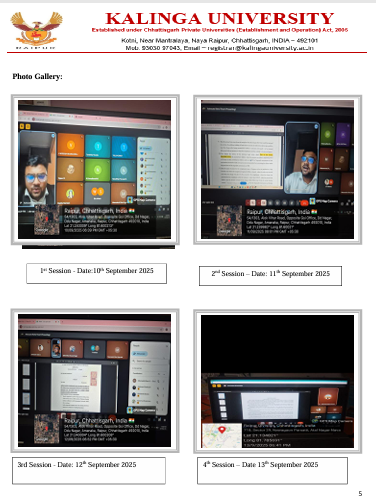

A Six-Day Online Certificate Course on “Legal Drafting and Contract Drafting” was organized by the Faculty of Law from 10th to 16th September 2025, providing participants with practical knowledge and skills in legal and contract drafting.

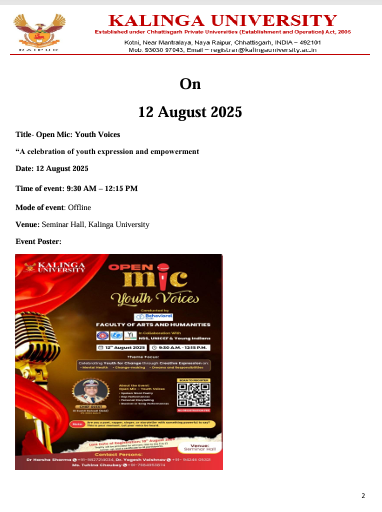


An “Open Mic: Youth Voices” programme was organized by the Behaviour Club, a unit of UNICEF at Kalinga University, in association with Young Indians (YI) and NSS, on 12th August 2025, providing a platform for young people to express their ideas, perspectives, and concerns on contemporary social issues.

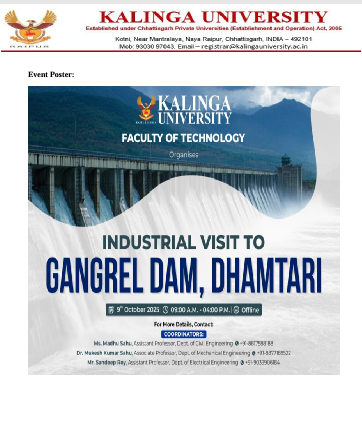


A One-Day Industrial Visit to Gangrel Dam, Dhamtari was organized by the Faculty of Technology on 9th October 2025, providing students with practical exposure to the functioning, management, and technological aspects of a major water resource infrastructure.


A Global Conference on “Cyber Violence and Digital Deception: Understanding, Preventing and Responding to Technology-Facilitated Crimes” was organized by the Faculty of Law on 20th–21st November 2025, focusing on awareness, prevention, legal responses, and emerging challenges associated with cyber violence and technology-facilitated crimes.


A National Seminar on “From Vachanas to Vision: Mahatma Basaveshwara’s Ideas in Contemporary Society” was organized by the Shaheed Veer Narayan Singh Research Chair (Faculty of Arts & Humanities and Faculty of Law) in association with the Innovation and Integrative Research Center Journal (IIRCJ) on 25th August 2025.
List - Strengthening Community Impact through Alumni Engagement in SDG Education
| Sl. No. | Event Name | Organized By | Date | Relevant SDGs |
|---|---|---|---|---|
| 1 | Alumni Talk – Pathways to Success: Alumni Share their Journey | Alumni Association Kalinga University | 14/12/2024 | 4, 8, 9, 10, 11, 17 |
Glimpse of the Events:
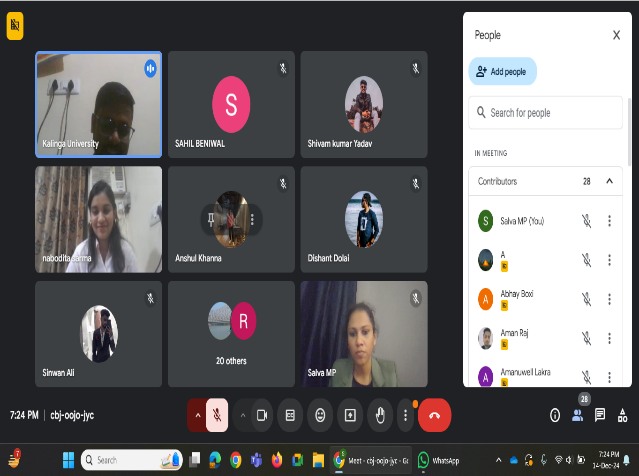

An “Alumni Talk – Pathways to Success: Alumni Share Their Journey” was organized by the Alumni Association, Kalinga University, on 14th December 2024. The session provided students with valuable insights into career pathways, professional experiences, employability, and personal growth through alumni interaction and knowledge sharing.
List : Details of Various Outreach Programmes, Guest Lectures, Seminars, Workshops, Hands-on Training Programmes, Hackathons, Masterclasses, Faculty Development Programmes (FDPs), Conferences and Other Academic/Professional Activities Conducted During the Academic Session 2024–25.
| Sl. No. | Faculty / Department | Date of Event | Event Category | Title of the Event | Aligned SDG Goal(s) | Remarks |
|---|---|---|---|---|---|---|
| 1 | IQAC | 12.07.2024 - 14.07.2024 | Conference | 2nd World Conference on Communication & Computing 2024 (2nd WCONF - 2024) | SDG 9, SDG 17 | Technology, research and collaboration |
| 2 | Faculty of Science | 22.07.2024 to 26.07.2024 | Internship / Experiential Learning | Inspire Internship Science Camp | SDG 4 | Quality education and science learning |
| 3 | Faculty of Law | 22.07.2024 to 27.07.2024 | FDP / Faculty Development | One Week Faculty Development Program (Online) on “Advanced Teaching Pedagogy and Research” | SDG 4 | Faculty capacity building and quality education |
| 4 | IQAC | 05.08.2024 to 09.08.2024 | Training / Workshop | Hands on IoT Training: Exposing Rural Students to Opportunities in STEM | SDG 4, SDG 9, SDG 10 | STEM skills, technology and inclusion |
| 5 | Faculty of Education | 09.08.2024 | Competition / Quiz | Intercollege Quiz Competition | SDG 4 | Learning and intellectual development |
| 6 | Faculty of Technology | 12.08.2024 | Guest Lecture | Guest Lecture on “Fuel Cell for Electric Vehicle Applications” | SDG 7, SDG 9, SDG 13 | Clean energy, innovation and climate action |
| 7 | IQAC | 12.08.2024 | Capacity Building / Outreach | Capacity Building Program at Indian College of Education, Mahasamund (C.G.) | SDG 4, SDG 17 | Capacity building and institutional partnership |
| 8 | Faculty of Science | 12.08.2024 | Webinar | Webinar on “Power Your Decisions with Data” | SDG 4, SDG 9 | Data literacy and digital skills |
| 9 | Faculty of C & M | 14.08.2024 | Guest Lecture / Career Guidance | Guest Lecture on “Job Opportunities in the UK” | SDG 4, SDG 8 | Career development and employability |
| 10 | Faculty of Science | 16.08.2024 | Competition / Cultural | Reel Making Competition on the theme “Pride of India” | SDG 4, SDG 11 | Creative learning and cultural expression |
| 1 | Faculty of Science | 16.08.2024 | Guest Lecture / Health Awareness | Guest Lecture on “Association of physical activity in reducing non-communicable diseases” | SDG 3 | Health and well-being |
| 12 | CCRC | 17.08.2024 | Master Class / Professional Development | Master class on “Grow as a Leader: A Program for First-time managers” | SDG 4, SDG 8 | Leadership and employability |
| 13 | Faculty of Law | 17.08.2024 | Competition / Moot Court | National Moot Court Competition | SDG 4, SDG 16 | Legal education and justice |
| 14 | Faculty of Education | 21.08.2024 | Guest Lecture | Guest Lecture on “Psychological Foundations of Effective Teaching” | SDG 3, SDG 4 | Well-being and quality teaching |
| 15 | Faculty of Pharmacy | 21.08.2024 | Guest Talk | Guest talk | SDG 3, SDG 4 | Health education |
| 16 | Faculty of CS & IT | 22.08.2024 | Research / Academic Activity | Research Paper Writing | SDG 4, SDG 9 | Research and knowledge creation |
| 17 | Faculty of Technology | 22.08.2024 | Competition / Quiz | Quiz Competition | SDG 4 | Learning and assessment |
| 18 | Faculty of Technology | 23.08.2024 | Seminar / Innovation | Seminar on “From Idea to Impact: Translating Innovation into Market Success” | SDG 8, SDG 9 | Innovation and entrepreneurship |
| 19 | Faculty of Technology | 23.08.2024 | Career Guidance | Civil - Professional Career opportunities after Civil Engineering | SDG 4, SDG 8 | Professional skills and employability |
| 20 | Faculty of Science | 27.08.2024 | Workshop | Bioinformatics - Workshop | SDG 3, SDG 4, SDG 9 | Health science, learning and technology |
| 21 | Faculty of Science | 27.08.2024 | Guest Lecture | FD - Guest Lecture | SDG 4 | Academic learning |
| 2 | Arts & Humanities | 27.08.2024 | Technical / Digital Activity | Express IT - 2024 | SDG 4, SDG 8 | Digital/communication skills |
| 23 | Faculty of C & M | 30.08.2024 | Competition / Entrepreneurship | Blueprints for Tomorrow: Business Plan Writing Competition | SDG 4, SDG 8, SDG 9 | Entrepreneurship and innovation |
| 24 | CCRC | 27.08.2024 to 14.09.2024 | Training / Placement | Campus Recruitment Training (CRT: 2024-25) - Phase I | SDG 4, SDG 8 | Employability and career readiness |
| 25 | Faculty of Pharmacy | 02.09.2024 | Expert Talk / Research | An Expert Talk on “Breaking Barriers: Creative Research Strategies” | SDG 3, SDG 4, SDG 9 | Health research and innovation |
| 26 | Faculty of Education | 03.09.2024 | Guest Lecture | Guest Lecture | SDG 4 | Academic learning |
| 27 | Faculty of Science | 04.09.2024 | Competition / Cultural | Green Ganesha Competition | SDG 11, SDG 12, SDG 13 | Eco-friendly cultural practice |
| 28 | Faculty of Science | 04.09.2024 | Competition / Cultural | Creative Writing Competition | SDG 4, SDG 11 | Creative and cultural learning |
| 29 | Faculty of Science | 07.09.2024 | Competition / Awareness | Online Quiz and Essay Writing Competition on International Day of Clean Air for Blue Skies | SDG 3, SDG 11, SDG 13 | Clean air, health and climate awareness |
| 30 | Faculty of Science | 13.09.2024 | Workshop / Training | Workshop on Fingerprint Development | SDG 4, SDG 16 | Forensic learning and justice |
| 31 | Faculty of C & M | 13.09.2024 | Seminar / Leadership | Session on “AI Leadership: The Future of Management” | SDG 4, SDG 8, SDG 9 | AI, leadership and innovation |
| 32 | CIF | 14.09.2024 | Hands-on Training | HoT Program on XRD | SDG 4, SDG 9 | Advanced scientific instrumentation |
| 3 | Faculty of Science | 16.09.2024 | Day Celebration / Awareness | World Ozone Day (Green Club) | SDG 13 | Ozone and climate awareness |
| 34 | Faculty of A & H | 17.09.2024 | Competition / Cultural | Face Painting Competition | SDG 4, SDG 11 | Creative and cultural expression |
| 35 | Faculty of Law | 17.09.2024 | Career Guidance | Career Counselling Session on UPSC and Judiciary | SDG 4, SDG 8, SDG 16 | Career development and public justice services |
| 36 | Faculty of Science | 17.09.2024 | Day Celebration / Awareness | World Micro-organisms Day | SDG 3, SDG 4 | Health and science awareness |
| 37 | Faculty of CS & IT | 18.09.2024 & 19.09.2024 | Competition / Entrepreneurship | Intra Institutional Start-Up Competition & Reward Best Start-Ups | SDG 8, SDG 9 | Entrepreneurship and innovation |
| 38 | Faculty of A & H | 18.09.2024 | Outreach / Community Engagement | Teaching English as a second language in rural areas | SDG 4, SDG 10 | Education and inclusion |
| 39 | Faculty of Pharmacy | 19.09.2024 | Awareness / Patient Safety | Building ADR Reporting Culture for Patient Safety | SDG 3, SDG 16 | Patient safety and responsible systems |
| 40 | Faculty of Science | 18.10.2024 | Workshop / Skill Development | Workshop on Furniture Designing | SDG 4, SDG 8, SDG 12 | Design skills and responsible production |
| 41 | Faculty of Science | 20.09.2024 | Hands-on Training | Fingerprint Forensics: Hand on Training in Latent Print Development | SDG 4, SDG 16 | Forensic skills and justice |
| 42 | IQAC | 16.09.2024 to 20.09.2024 | Hands-on Training | One Week Hands on Training on ‘Robotics’ | SDG 4, SDG 9 | STEM and robotics skills |
| 43 | CIF | 21.09.2024 | Hands-on Training | HoT Program on Cinematography | SDG 4, SDG 8 | Creative and professional skills |
| 4 | CCRC | 27.08.2024 to 14.09.2024 | Training / Placement | Campus Recruitment Training (CRT: 2024-25) - Phase II | SDG 4, SDG 8 | Employability and career readiness |
| 45 | Faculty of Education | 09.09.2024 to 24.09.2024 | FDP / Faculty Development | (Online) FDP on “The Role of Research and Higher Education in the Growth of Small and Medium Enterprises” | SDG 4, SDG 8, SDG 9 | Research, entrepreneurship and innovation |
| 46 | Faculty of Education | 26.09.2024 | Guest Lecture | Guest Lecture on “Crafting Effective Lesson Plans: A Guide for Future Educators” | SDG 4 | Quality teaching |
| 47 | Faculty of Law | 28.09.2024 | Capacity Building | Capacity Building Program on “Constitutional Values and Ethics Inside the Classroom” | SDG 4, SDG 16 | Ethics, citizenship and justice |
| 48 | Faculty of Law | 28.09.2024 | Career Guidance | Building a Career in Corporate Sector: Opportunities & Challenges | SDG 4, SDG 8 | Career readiness |
| 49 | Faculty of C & M | 28.09.2024 | Workshop | Workshop on “GST” | SDG 4, SDG 8, SDG 16 | Financial and regulatory literacy |
| 50 | Faculty of C & M | 28.09.2024 | Webinar / Financial Literacy | MCX Educational Webinar on 'Commodities Derivatives' for Girl Students | SDG 4, SDG 5, SDG 8 | Financial education and gender inclusion |
Records 1–50 of 168
Kalinga University promotes Sustainability Literacy as an essential component of Education for Sustainable Development (ESD), enabling students, faculty, and staff to understand sustainability challenges and contribute responsibly to achieving the United Nations Sustainable Development Goals (SDGs). The University integrates sustainability concepts into academic curricula, value-added courses, awareness programmes, workshops, seminars, and community outreach initiatives. These activities develop knowledge and awareness related to environmental protection, climate action, responsible consumption, biodiversity conservation, social responsibility, and ethical decision-making.
Through interdisciplinary learning and experiential activities, students are encouraged to connect sustainability principles with real-world challenges and develop practical solutions. Campus initiatives such as waste management, energy conservation, water management, renewable energy awareness, biodiversity promotion, and reduction of single-use plastics further strengthen sustainability-oriented behaviour. Community engagement programmes extend sustainability learning beyond the campus by promoting awareness and responsible practices among local communities.
Sustainability literacy also supports the development of critical thinking, problem-solving, collaboration, and responsible citizenship. By embedding sustainability across teaching, research, institutional practices, and community engagement, Kalinga University seeks to nurture environmentally conscious, socially responsible, and future-ready graduates who can actively contribute to sustainable development at local, national, and global levels.
University Approach to Measuring Sustainability Literacy
1. Curriculum-Based Sustainability Education
2. Sustainability Literacy Evaluation and Impact Assessment
3. Learning Through Sustainability Projects and Community Engagement
4. Collaborative Partnerships for Sustainable Development
5. Research and Innovation for SDG-Oriented Development
6. Sustainability Performance, Impact and Outcomes
The University’s approach to sustainability literacy contributes to:
Experiential Learning for Sustainability Competency Development
Experiential learning is an important component of sustainability literacy because it connects theoretical knowledge with practical experience. Through active participation in projects, field visits, community engagement, campaigns, laboratory activities, and problem-solving exercises, students gain a deeper understanding of sustainability challenges and their potential solutions. Such learning experiences encourage students to observe, analyse, reflect, and respond to real-world environmental and social issues. By engaging multiple dimensions of learning, experiential education supports better understanding and long-term retention of sustainability concepts. It also strengthens critical thinking, creativity, collaboration, responsible decision-making, ethical awareness, and problem-solving abilities. Through reflection, presentations, project reports, assessments, and feedback, students demonstrate how their knowledge has developed and how effectively they can apply sustainability principles in academic, professional, and community contexts. This approach enables the University to assess sustainability literacy not only through theoretical knowledge but also through practical application, behavioural engagement, and demonstrated commitment to sustainable development.